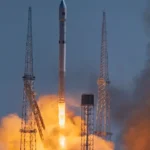


Shanghai-based operator of the SpaceSail constellation secures additional funding as China races to expand its low-Earth-orbit satellite networks.
State-backed Shanghai Spacecom Satellite Technology (Spacecom) has completed a 6.98 billion yuan ($1 billion) Series B financing round, setting a new record for the largest single funding round in China’s satellite industry.
The transaction, announced by the Shanghai United Assets and Equity Exchange on Aug. 17, saw 18 investors buy approximately 13.9% of the company, giving it a post-money valuation of roughly 50 billion yuan.
The second-phase National Green Development Fund and other members of a 24-party investment consortium contributed about 5.764 billion yuan for an 11.52% stake. Shanghai United Investment, the company’s founder and largest single shareholder, invested a further 552 million yuan. Most of Spacecom’s existing investors also participated in the new round.
Shanghai United Investment now holds 44% of Spacecom, known in Chinese as Shanghai Yuanxin Satellite Technology, while Shanghai Information Investment holds 16.1%, leaving them as the company’s two largest shareholders.
Funding China’s satellite ambitions
The fundraising process had been structured to preserve state control. A June 22 announcement said Spacecom intended to raise funds representing no more than 20% of its equity, with the final amount depending on market demand. Existing shareholders would retain at least 80%, while new outside investors could hold no more than 20% in aggregate.
The company also imposed unusually high entry requirements. Each prospective investor or consortium had to commit at least 5 billion yuan, while a consortium could contain no more than 25 members and each member had to invest at least 100 million yuan.
This meant that, at most, three investment groups could qualify as new shareholders, a limit also specified in the fundraising announcement.
The proceeds will mainly be used to build the company’s Qianfan (Thousand Sails) satellite constellation which is marketed internationally as SpaceSail, as well as as fund technology research and development, expand its market presence and cover day-to-day operating expenses.
Spacecom previously raised 6.7 billion yuan in a Series A round announced in February 2024, also a record for a single financing round in China’s satellite industry. The round was led by China Development Bank’s Manufacturing Transformation and Upgrading Fund, with Shanghai United Investment and a range of other existing and new investors participating.
Spacecom was founded in 2018 under the leadership of Shanghai United Investment, which is wholly owned by the Shanghai government. It is the sole builder and operator of the G60 SpaceSail constellation, one of China’s major low-Earth-orbit satellite projects.
The constellation is planned to be built in three phases, ultimately creating a network of 15,000 satellites in orbit. The company plans to have 648 satellites in orbit by the end of 2026, providing coverage across selected regions.
A long road to commercial returns
Spacecom aims to provide global users with low-latency, high-speed and highly reliable satellite broadband services. The system is designed to be compatible with existing communications standards and eventually support 6G, with the goal of providing seamless connectivity across terrestrial, satellite, airborne and maritime networks.
On July 5, the company used a Long March 8A rocket for the first time to launch constellation satellites from the Hainan International Commercial Space Launch Center. The mission increased the number of flat-panel satellites launched on a single rocket to 20 and brought the constellation’s total to 238 satellites.
The company’s financial figures, however, underline just how early it remains in its development. Total assets increased steadily from 6.29 billion yuan in 2023 to 10.2 billion yuan in 2025, reaching 10.3 billion yuan at the end of the first quarter of 2026.
Spacecom remains in a period of heavy research spending and production ramp-up. Its 2025 revenue was just 188,700 yuan, while total and net losses both came to 890 million yuan. In the first quarter of 2026, the company generated no revenue but recorded a total loss of 103 million yuan and a net loss of 123 million yuan.
The latest funding round therefore gives the company substantial capital to accelerate construction of its planned constellation — but the 50 billion yuan valuation is being placed on a business that has yet to generate meaningful commercial revenue.
Source: