

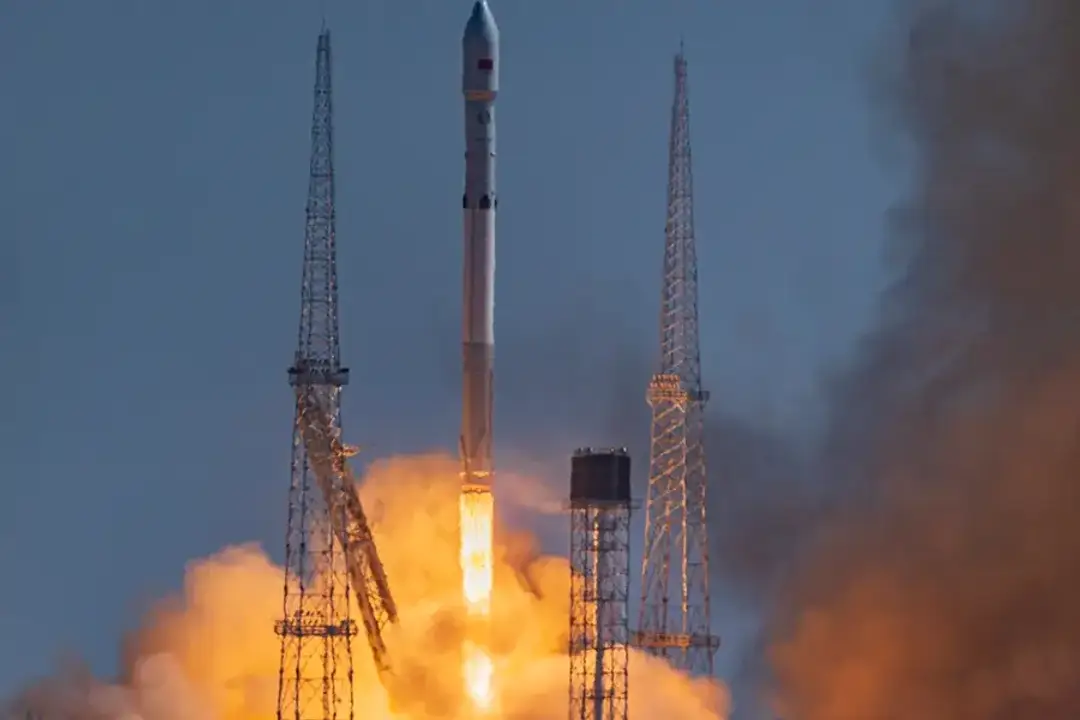
LandSpace has delivered 10 satellites for China’s SpaceSail constellation, marking a shift toward large-scale commercial launches.
By Li Minging
China’s private space sector has taken a step toward large-scale satellite deployment, with LandSpace successfully launching 10 communications satellites for state-backed Shanghai Spacecom Satellite Technology (Spacecom).
The ZQ-2E Y7, an improved version of LandSpace’s Zhuque-2 liquid oxygen-methane rocket, lifted off from the Dongfeng Commercial Aerospace Innovation Test Zone on Sept. 15 Beijing time, carrying 10 satellites into a 900-kilometer orbit for the SpaceSail low-Earth-orbit satellite constellation, known in Chinese as Qianfan (Thousand Sails).
The mission was the ninth flight of the Zhuque-2 series and the first time a Chinese private commercial space company has been entrusted with a batch launch for a major satellite internet constellation, according to Ma Haijing, general manager of marketing at LandSpace.
The launch marks a new stage for China’s private space industry, moving from experimental payloads to regular constellation deployment.
From test satellites to constellation workhorses
Private rockets have previously participated in SpaceSail launches, but on a much smaller scale.
On June 9, an earlier Zhuque-2E rocket carried SpaceSail DTC01, a test satellite designed for direct-to-cell communications, into orbit. That mission demonstrated that a private rocket could participate in the constellation’s launch program, but involved only a single experimental payload.
Zhu Keli, founder of the National Institute for New Economy Research, said the latest mission represented a more significant change.
Private launch companies had previously focused mainly on experimental missions and rideshare payloads, serving as a supplementary source of launch capacity. Taking on large-scale constellation deployment shows that their reliability and engineering delivery capabilities have been tested in practice and that they are becoming part of the launch capacity supporting China’s satellite internet build-out, he said.
That should give constellation operators more launch options at a time when satellite numbers are rising faster than available rocket capacity. For private rocket companies, meanwhile, regular constellation contracts can provide the volume needed to drive rocket production and high-frequency launch capabilities.
LandSpace said its Tianque-series liquid oxygen-methane engines had accumulated 170,000 seconds of test firing as of May. The Zhuque-2 series has completed nine flights, making it one of the most extensively tested liquid-fuel rocket families in China’s private space sector.
The Zhuque-2E’s development has also focused on increasing launch frequency. The fifth mission verified its designed payload capacity and complex high-orbit deployment capabilities. The sixth followed just 26 days later, demonstrating the company’s ability to organize missions at a higher cadence. The seventh has now expanded the rocket’s role into constellation deployment, increasing the number of satellites carried per launch and potentially lowering costs for customers.
SpaceSail faces a launch-capacity race
The need for additional launch capacity is becoming more urgent as China’s low-Earth-orbit satellite constellations move into intensive deployment.
Spacecom had launched 238 satellites by the time of the latest mission and aims to complete the first phase of a 324-satellite network by the end of 2026, according to Shang Lin, general manager of the satellite systems division at the Shanghai-based company, known in Chinese as Yuanxin Satellite.
The constellation is planned in three phases. The first will comprise 648 satellites for regional coverage; a second 648 will bring the total to 1,296 satellites for global coverage; and the third phase envisages more than 15,000 satellites supporting a range of integrated services.
As constellation sizes grow, launch capacity will become increasingly important. Shang said the commercial space industry was moving from high-cost, expendable launches toward lower-cost, reusable rockets and large-scale constellation deployment. Reusable launch vehicles can spread launch costs over multiple missions, while larger constellations can support greater volumes of downstream applications.
LandSpace is developing the Zhuque-2E alongside its Zhuque-3 reusable rocket. The two share several key technologies: both use TQ-12A engines on the first stage and TQ-15A engines on the second, while stage separation uses aerodynamic push rods.
The Zhuque-2E is intended for routine commercial launches and has a maximum payload capacity of 6 tons. Zhuque-3 is designed for higher payloads and more frequent launches, with a maximum designed payload of 18 tons when recovered.
LandSpace says the two rockets will allow it to cover most of the launch requirements of China’s commercial space sector.
Shanghai builds a commercial space ecosystem
Shanghai is also expanding its commercial space infrastructure as SpaceSail moves toward commercial operations.
The Shanghai Municipal Government’s 15th Five-Year Plan for strategic emerging industries calls for greater integration of satellite internet with BeiDou, 6G and artificial intelligence, as well as faster deployment of the SpaceSail low-Earth-orbit communications constellation.
The plan also calls for development of commercial rockets, including larger-diameter, higher-thrust reusable launch vehicles and key technologies such as high-thrust engines and return-control systems.
In April, Shanghai Commercial Aerospace Sea Launch Technology was established in Minhang district with registered capital of 1.1 billion yuan ($§64 million). Its shareholders include entities involved in rockets, satellites, launch facilities and investment, including Shanghai Guosheng, China Commercial Aerospace and Qianfan operator Shanghai G60 Starlink.
The company is developing a sea-launch model under which rockets can be assembled and tested in Shanghai, transported from a local port and launched from an offshore platform. The model is expected to increase overall operational efficiency by more than two-thirds and potentially cut launch preparation time from about 20 days to roughly one week.
For LandSpace, however, the latest SpaceSail mission is not the destination. Ma said the company would continue work on routine Zhuque-2E commercial launches while advancing the engineering development of reusable Zhuque-3 technology, with the goal of turning its existing technical capabilities into stable, sustained commercial launch capacity.