
The deployment of a net system to catch the Long March booster could lower launch costs for lunar missions and satellite constellations, but the economic viability remains unproven.
By Da Cheung
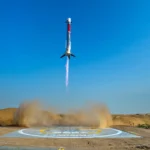
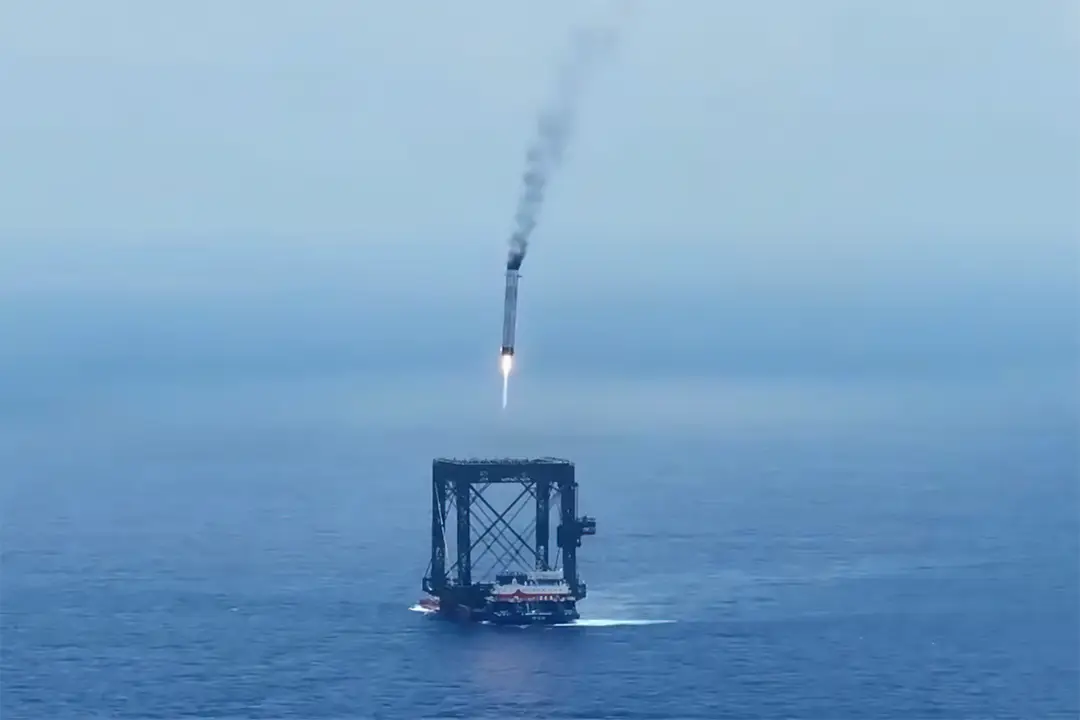
China has successfully executed a new approach to recovering a large liquid-fueled rocket booster for reuse, catching the first stage of a Long March 10B rocket in a giant net suspended from an offshore platform rather than landing it vertically on legs like SpaceX.
The test marks a technical milestone that elevates the country’s state-driven space program and makes Beijing only the second global power after the U.S. to demonstrate the retrieval of major orbital-class launch infrastructure.
The July 10 launch from the Hainan commercial spaceport saw the rocket deliver its payload into orbit before its first-stage booster — the massive bottom portion of the rocket that provides the initial thrust to escape gravity — returned to Earth. It was caught on a maritime vessel 430 kilometers away in the South China Sea.
The demonstration could reduce the weight and fuel penalties associated with conventional propulsive landings, an important step toward lowering launch costs for Beijing’s planned 2030 crewed lunar missions and the rapid deployment of massive satellite networks. However, as China’s state-backed and private space sectors celebrate the achievement, they still face a daunting competitive benchmark in Elon Musk’s SpaceX, which recently went public and boasts a massive lead in flight heritage.
A novel catch at sea
In a sharp departure from the vertical landing legs used by SpaceX’s workhorse Falcon 9, China utilized a novel sea-based flexible net-catch system. The returning Long March 10B booster descended into a 36-meter-high net erected on the “Navigator,” a 25,000-ton maritime platform.
Chinese aerospace officials frame this as a highly efficient engineering choice. Xu Xuelei, an official at the state-owned China Aerospace Science and Technology Corporation, previously told Cailian Press that the net system absorbs most of the rocket’s kinetic energy upon impact. According to Xu, this drastically reduces the need for heavy landing gear on the rocket itself and lowers the precision required for the engine’s thrust adjustments during descent.
A representative from rocket company Jianyuan Technology, speaking to Cailian Press, claimed that recovering a rocket on a sea platform reduces payload capacity loss to about 23%, compared with a 40% loss if the rocket has to carry enough fuel to fly back to a launchpad on land.
However, the long-term scalability and economic viability of China’s net-catch method remain entirely untested compared with SpaceX, which has successfully landed orbital rockets vertically more than 600 times.
The race for the moon and low Earth orbit
The successful recovery sets the stage for two distinct arenas of international competition: lunar exploration and the commercialization of low Earth orbit — the area of space relatively close to Earth where most communications satellites operate.
The Long March 10 series is the backbone of Beijing’s plan to put Chinese astronauts on the moon by 2030. The U.S. is operating on a similar timeline, with NASA’s Artemis program targeting a crewed lunar landing by 2028. NASA is relying on lunar landers developed by SpaceX or Jeff Bezos-backed Blue Origin to achieve this goal.
Notably, the Long March 10B currently only recovers its first-stage booster, much like the Falcon 9. SpaceX’s next-generation Starship is designed to be fully reusable, though it has not yet successfully recovered its upper spacecraft stage. During a May test flight, the Starship spacecraft reached the Indian Ocean before erupting in flames upon impact — an outcome that was expected, according to the company.
Closer to Earth, China is rushing to build its Thousand Sails and Guowang satellite internet constellations to rival SpaceX’s Starlink. Deploying tens of thousands of satellites requires cheap, high-frequency launches. The Long March 10B can carry at least 16 tons to low Earth orbit in its reusable configuration, which Chinese officials say will significantly lower launch costs once the rocket achieves stable, repeated flights.
Commercial space startups chase SpaceX’s shadow
The state-led success of the Long March 10B is intensifying a high-stakes domestic commercial space race. Chinese startups are rushing to replicate reusable technology to secure their financial futures.
Landspace and CAS Space, two prominent Chinese commercial rocket developers, both updated their prospectuses for initial public offerings on Shanghai’s tech-focused STAR Market in late June. According to their filings, Landspace expects to achieve profitability as early as 2029, while CAS Space projects profitability between 2029 and 2030.
However, these financial projections rely entirely on the companies successfully mastering and commercializing reusable rockets — a feat neither has fully accomplished. Landspace’s Zhuque-3 debuted in December 2025. While it reached orbit, its first stage failed to land successfully, a procedure known in the industry as “stick the landing.” CAS Space’s Kinetica-2 debuted successfully in March 2026, but the company is still planning its recovery tests. Other domestic competitors, including Galactic Energy and Deep Blue Aerospace, are also developing their own reusable vehicles.
Looming over China’s entire space sector is the shadow of SpaceX, which made its debut on the Nasdaq on June 12 with a valuation of $2 trillion, has successfully linked low-cost rocket launches, satellite communications and artificial intelligence into a massive capital loop. For China’s emerging commercial space players, proving their technology can actually survive the fiery return to Earth is only the first step toward competing in a market SpaceX has already redefined.
Sources