

Commercial rocket maker says its Gravity-1 launcher has entered large-scale commercial service after a third successful mission, as it aims to start the IPO process in 2027.
By Wang Hui
Chinese commercial launch company Orienspace says it has entered the next stage of commercial operations after the third successful launch of its Gravity-1 rocket, while pressing ahead with fundraising and laying the groundwork for a planned initial public offering.
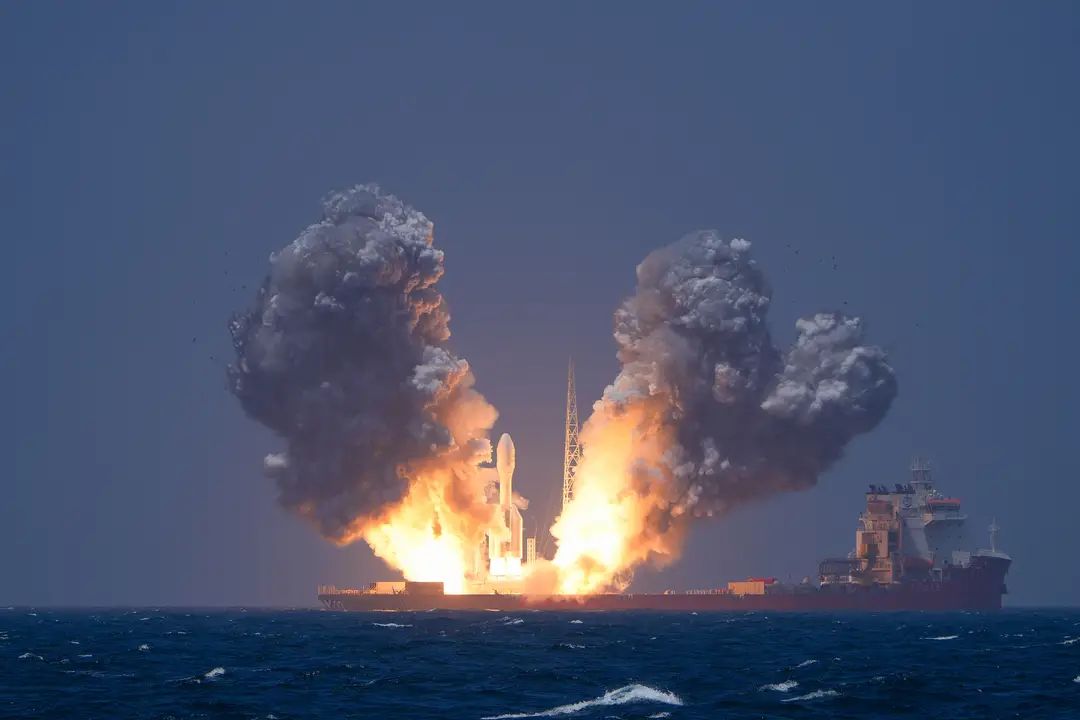
The company completed the latest mission at 10:54 a.m. Beijing time on July 22, launching its Gravity-1 (Y4) rocket from the East China Sea. The mission placed nine satellites into their planned orbit and carried out an additional payload experiment.
The flight marked Gravity-1’s third successful mission and its first launch from a far-offshore location. Orienspace says the vehicle, which it describes as the world’s largest solid-fuel launch vehicle by payload capacity, has now demonstrated sufficient reliability to support regular commercial operations.
Peng Haomin, co-founder and vice-president of Orienspace, said the company had moved beyond proving the technology and could now provide routine launch services for satellite constellation deployments, giving it a stable source of commercial revenue.
The operational progress comes alongside advances in financing. Peng said Orienspace has completed two funding rounds this year, plans to complete its corporate restructuring into a joint-stock company before the end of 2026 and expects to begin IPO preparation and regulatory guidance in 2027. The company is currently raising a Series C round.
Expanding China’s launch capacity
China’s rapidly growing low-Earth orbit satellite plans have been constrained by a shortage of launch capacity, creating what industry executives often describe as a mismatch between “many satellites and too few rockets.”
Peng said the challenge for commercial launch providers has shifted from simply reaching orbit to lowering launch costs, increasing launch frequency and building sustainable business models.
Orienspace has adopted a dual-track strategy, using revenue generated by the solid-fuel Gravity-1 programme to finance development of its reusable Gravity-2 liquid rocket, which uses liquid oxygen and kerosene propellants.
The company expects Gravity-2 to be ready for its maiden flight in the fourth quarter of 2026. Orienspace also plans three additional multi-satellite launches before year-end, including missions supporting the deployment of large satellite internet constellations.
First private launch from the East China Sea
Although designated the Y4 mission, the launch was only Gravity-1’s third flight because regulatory approval for the Y3 mission was delayed.
Unlike its previous two launches from coastal waters near Haiyang in eastern Shandong province, the latest mission took place about 170 kilometres east of Shanghai in the East China Sea. Orienspace said it was the first time a privately developed Chinese commercial rocket had launched from waters off the Yangtze River Delta.
Chief designer Xu Guoguang said operating further offshore presented additional technical challenges, including rougher sea conditions, longer voyages and greater exposure to salt spray and humidity, all of which required additional protection for both the launch platform and the rocket.
The company reinforced its launch platform and used meteorological satellite data and real-time monitoring to manage weather and sea-state risks.
Xu said offshore launches offer important advantages over land-based sites, including greater safety because debris falls into the ocean rather than populated areas.
They also provide greater flexibility in reaching orbital inclinations required for many low-Earth orbit satellite constellations. China’s four existing inland launch centers cannot directly support southbound launches into some desired orbits, whereas offshore platforms can reposition to meet mission requirements.
Gravity-1’s low-centre-of-gravity design also makes it well suited to ship-based launches, Xu said.
Bigger rockets, lower costs
Founded in June 2020, Orienspace has developed a portfolio including its Gravity launch vehicles, Yuanli rocket engines and aerospace information systems, while building an integrated business spanning research, testing, manufacturing and launch services.
The company deliberately chose to begin with solid-fuel rockets, arguing that the technology offered a faster development cycle, a more mature supply chain and earlier commercial revenue than reusable liquid launch vehicles.
Gravity-1 can carry 6.5 metric tonnes to low-Earth orbit or 4.2 metric tonnes to a 500-kilometre sun-synchronous orbit. Orienspace says the rocket can deploy up to 30 satellites weighing around 100 kilograms each in a single mission.
Peng said satellites are becoming progressively heavier, with average weights rising from around 100 kilograms to 300 kilograms and potentially reaching 800 kilograms in future, increasing demand for higher-capacity launch vehicles.
Gravity-2 is designed to carry 21.5 metric tonnes to low-Earth orbit or 15 metric tonnes to a 500-kilometre sun-synchronous orbit—more than triple Gravity-1’s capacity—and transport up to 30 satellites weighing 500 kilograms each.
Peng said larger rockets reduce launch costs because many operational expenses remain similar regardless of vehicle size. Orienspace also aims to cut costs through modular rocket designs, larger payload fairings, offshore launches, rideshare missions, standardized engineering and mass production.
The company said it has already reduced launch prices per kilogram by about half since Gravity-1’s maiden flight in January 2024, compared with previous industry pricing of nearly 100,000 yuan ($14,760) per kilogram.
Peng said Gravity-2 is expected to achieve launch costs comparable to SpaceX’s Falcon 9, currently around $3,000 per kilogram, although the company did not specify when that target would be reached.
Peng said both solid and reusable liquid rockets would remain necessary for China’s commercial space industry for the foreseeable future, as reusable technology is still maturing while demand for launch services continues to outstrip supply. He described 2026 as the industry’s first year of mass production and said Orienspace aims to help close China’s launch capacity gap as satellite constellation deployments accelerate.
Source:
Economic Observer