
LandSpace has successfully recovered Zhuque-3’s first stage, moving China’s reusable rocket race closer to the harder test: rapid, low-cost reuse.
By Li Hailun
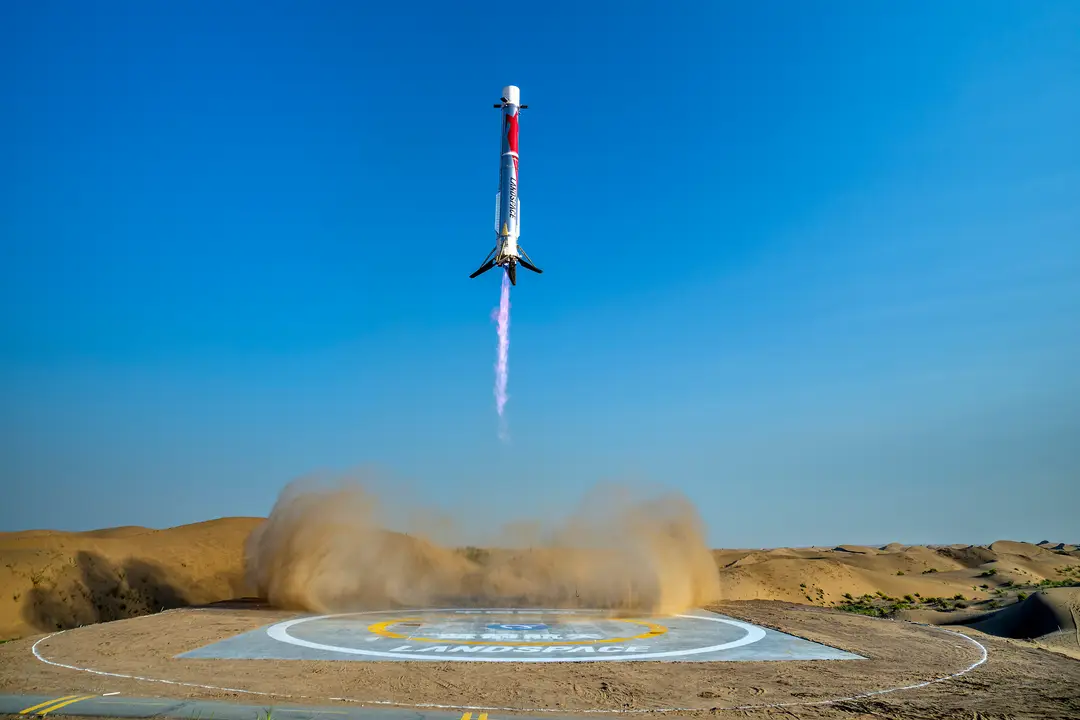
China has achieved its first successful land-based recovery of an orbital-class rocket, with LandSpace’s Zhuque-3 completing a vertical touchdown on Aug. 19, according to state media. The mission marks a major step forward in the country’s reusable launch vehicle development.
The Zhuque-3 Y2 lifted off from Dongfeng Commercial Space Innovation Test Zone, successfully placing a payload into orbit and landing at the company’s designated site in Minqin county, Gansu province. The first stage performed a powered vertical recovery with landing legs — the first such feat for a Chinese rocket on land.
The mission validated the engineering feasibility of LandSpace’s technical approach combining liquid-oxygen methane propulsion, stainless steel structure and landing-leg vertical recovery.
The flight comes less than a year after Zhuque-3’s debut mission in December 2025, when its first stage failed to make a soft landing during the final stage of the recovery attempt. It represents what LandSpace has called its “second major exam” en route to routine commercial operations.
The timing is also significant as LandSpace is currently in the Shanghai Stock Exchange STAR Market IPO review process. The maturity of its reusable rocket technology and its ability to establish a reliable commercial launch business have been key areas of scrutiny.
Refining the final descent
From Y1 to Y2, LandSpace concentrated improvements on the terminal landing phase.
During the December 2025 maiden flight, the second stage reached orbit but the first stage suffered an anomaly in the final landing burn and failed to achieve soft touchdown. While re-entry ignition, aerodynamic gliding and guidance performed as expected, the last few kilometres proved problematic.
For Y2, LandSpace kept the overall two-stage, stainless steel configuration but introduced several upgrades. The landing propulsion architecture was simplified by reducing the number of landing engines, decreasing system complexity and improving control reliability. A new impact point prediction and safety control feature was added, enabling autonomous flight termination based on real-time trajectory calculations.
The second-stage engine received a larger expansion-ratio nozzle to boost performance and payload capacity, laying groundwork for future low-orbit constellation missions.
The rocket also carried a non-pyrotechnic stacking separation system developed by LandSpace for multi-satellite launches, designed to reduce separation shock and improve reliability for future constellation deployment.
Twelve consumer-grade action cameras, adapted for spaceflight, were mounted on the rocket to document the full flight profile.
Two paths to reusability
Zhuque-3’s approach differs from another major Chinese reusable-rocket milestone achieved this year.
On July 10, the Long March 10B first stage returned to a recovery platform at sea and was successfully captured by a net system. It was China’s first successful controlled recovery of a launch vehicle first stage and the world’s first net-based rocket recovery.
The two systems reflect different engineering choices. The Long March 10B does not use landing legs. Its first stage is captured by a net on the offshore platform, with the platform handling much of the impact absorption and stabilization. Zhuque-3, by contrast, uses grid fins, attitude-control systems and landing legs to guide the first stage to a powered landing.
Over the past year, China’s reusable rocket validation has accelerated sharply. Since late 2025, multiple vehicles have entered testing phases. Zhuque-3, Long March 12A, and several commercial players have conducted orbital recovery experiments.
That means successful recovery is increasingly becoming a baseline requirement rather than the final objective. The more important measures will be how many times a rocket can fly, how quickly it can be prepared for its next mission, how frequently it can launch and, ultimately, how much it costs to put each kilogram of payload into orbit.
The economics of reuse — and the next test
For LandSpace, the IPO context makes this success particularly significant. The company’s STAR Market application was accepted on Dec. 31, 2025, and is now in the inquiry stage, with the company seeking to raise 7.5 billion yuan
This mission delivers a complete engineering validation for the methane-reusability pathway LandSpace has pursued since 2023, when Zhuque-2 became the world’s first methane-fuelled rocket to reach orbit. Zhuque-3 Y1 achieved orbit in 2025, and now Y2 has added successful stage recovery.
Yet recovery is not reuse. In conventional expendable rockets, propellant accounts for only 1%-3% of launch cost, while the first stage can represent about 70% of the vehicle’s total value. Flying that stage 10 or 20 times could dramatically reduce costs — but only if the economics work.
Recovering a stage requires carrying extra propellant for the return journey, plus grid fins, landing legs and control systems. After touchdown, every component must be inspected. How many engines need overhaul, which parts require replacement, and how extensive requalification testing must be — these factors dictate the true cost and turnaround time.
There is a distinction between recovery count and relaunch count. Recovery tallies how many stages were successfully returned; relaunch measures how many actually flew again.
SpaceX illustrates the difference. By July, a Falcon 9 first-stage booster had completed 36 flights, setting a new record for orbital rocket reuse. The commercial advantage comes not simply from bringing boosters back, but from turning that capability into a sustained launch cadence. SpaceX’s Falcon 9 fleet has also benefited from the enormous demand created by its Starlink constellation. Reuters estimates that Starlink accounted for about 79% of Falcon 9 missions by early August 2026.
LandSpace has said it plans to attempt a first reuse flight as soon as its recovery tests provide sufficient confidence. If Zhuque-3 can complete the full cycle of launch, recovery, inspection, maintenance and relaunch, it will have passed a much harder test than simply landing.
For now, Y2 has given LandSpace its second major engineering success. The next test is to make the rocket fly again
Source:
Tencent Technology