

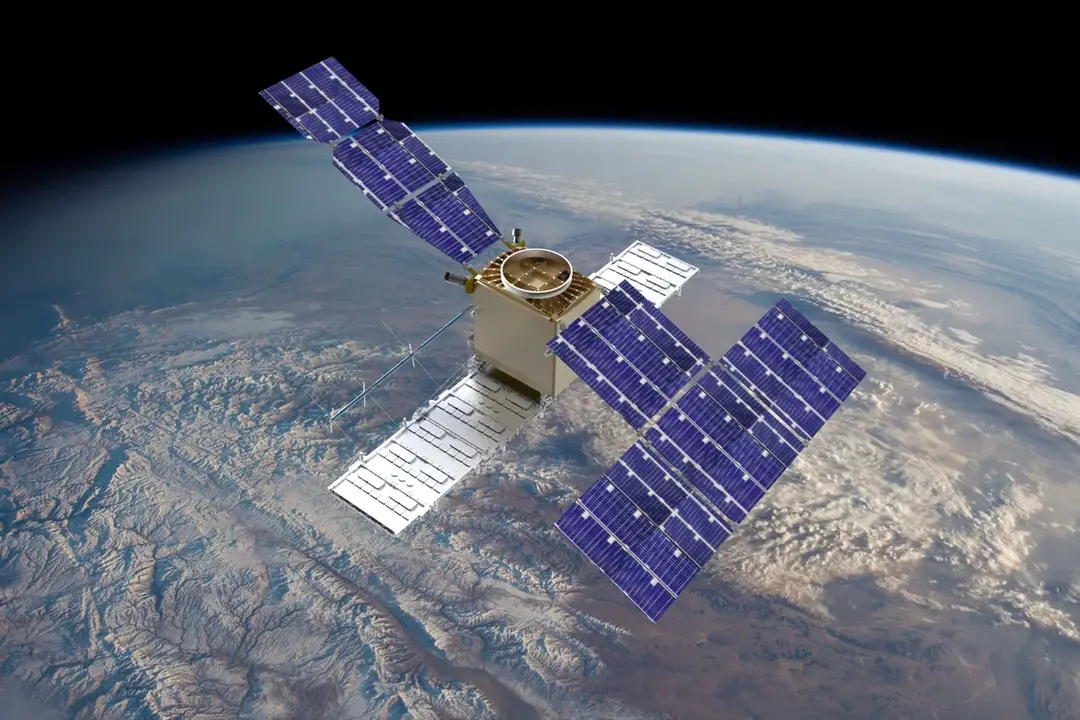
The new venture aims to build an entirely domestic orbital computing network, eventually linking satellite and ground-based computing resources.
By Song Shilan
Zhongke Xingyun Intelligent Technology officially launched operations in Hefei on Nov. 9, with registered capital of 1.5 billion yuan ($225 million), as China moves to develop computing infrastructure in space.
The company was formally established at the 2026 Space Cloud Industry Ecosystem Conference and Zhongke Xingyun Founding Ceremony in Hefei, central Anhui province. The venture aims to build an entirely domestic orbital computing network, Chairman Shao Zongyou told the ceremony. He outlined an ambitious plan with the ultimate goal of achieving what the company calls a system of “parity between space and ground” – an integrated network in which computing resources in orbit and on Earth can work together.
Tackling the bottlenecks in space computing
China’s commercial space industry is shifting its focus from building and launching satellites to operating large-scale constellations. But as these networks expand, limitations in existing infrastructure are becoming increasingly apparent.
Remote-sensing satellites currently transmit images back to Earth for processing, a system that can significantly delay the availability of data. Information collected from the oceans and from low-altitude economic activities can also be difficult to transmit to the ground in a timely manner. Meanwhile, the industry lacks common technical standards for building and operating satellite constellations.
“Space computing is not simply a matter of moving ground-based computing equipment onto satellites,” Shao said. It involves a complex systems-engineering challenge encompassing remote sensing, semiconductors, space networks, thermal management, energy and constellation control.
Companies that can establish a shared, dispatchable and commercially operable computing network in orbit will be better positioned to shape the next generation of the aerospace information industry, he said.
A three-stage plan for an integrated network
Shao outlined a three-stage development strategy, progressing from computing data in space to closer integration between orbital and terrestrial infrastructure.
The first stage, combining sensing and computing, will enable satellites to process information as they collect it, rather than transmitting raw data back to Earth before analysis. The aim is to deliver near-real-time processing capabilities directly in orbit.
The second stage will integrate communications and computing through high-speed links between satellites and networked orbital processing. This is intended to support the coordinated operation of large remote-sensing constellations and the high-throughput processing and delivery of space-based information.
The final stage will bring together computing resources across satellites to create large-scale, high-performance orbital data centers. The ultimate objective is a unified space-and-ground network capable of coordinating communications, sensing, computing and applications.
The company also envisages new models for billing and settling computing services, eventually enabling the monetization of space-based computing through AI tokens.
Backed by an industrial ecosystem
The company’s ambitions are supported by a group of six founding industry participants whose businesses span the space-computing supply chain.
Hygon Information Technology (688041.SH) provides domestically developed high-end computing chips, while Dawning Information Industry (Sugon) (603019.SH) supplies servers and intelligent computing infrastructure. Geovis Insighter (920116.BJ) contributes satellite tracking, telemetry and control capabilities, and Sugon Data Energy provides thermal management solutions for computing infrastructure.
Airsat Technology Group (Zhongke Satellite Technology) brings expertise in building and operating integrated sensing-and-computing constellations, while Geovis Technology (688568.SH), the parent of Geovis Insighter, covers space-based data and information services.
Shao said this combination would allow the company to draw on existing terrestrial computing technologies and applications. Hygon’s chip technology provides the underlying computing platform, while Dawning Information’s expertise in computing networks could help extend existing ground-based applications into space.
Hefei was chosen as the company’s base because of the city’s growing investment in the aerospace information industry and its supporting industrial ecosystem.
The city is now home to more than 190 companies and institutions involved in commercial space activities, with the sector’s industrial chain valued at more than 10 billion yuan. Its capabilities extend across satellite manufacturing, core components, launch vehicles and constellation networking.
Hefei also has a well-developed computing industry, providing an existing technological foundation that Zhongke Xingyun hopes to extend into space through closer coordination between orbital and terrestrial resources.
Once its space infrastructure is established, the company expects it to support applications including natural resource surveys, emergency response and disaster prevention, and the low-altitude economy. It also plans to connect the infrastructure to service nodes on China’s national computing network, providing integrated space-and-ground computing services to customers worldwide.
Source:
Hefei Daily
