
Chengdu-based satellite maker holds orders for 114 AI satellites worth 3.48 billion yuan as it makes its third attempt to go public.
By Li Mingming
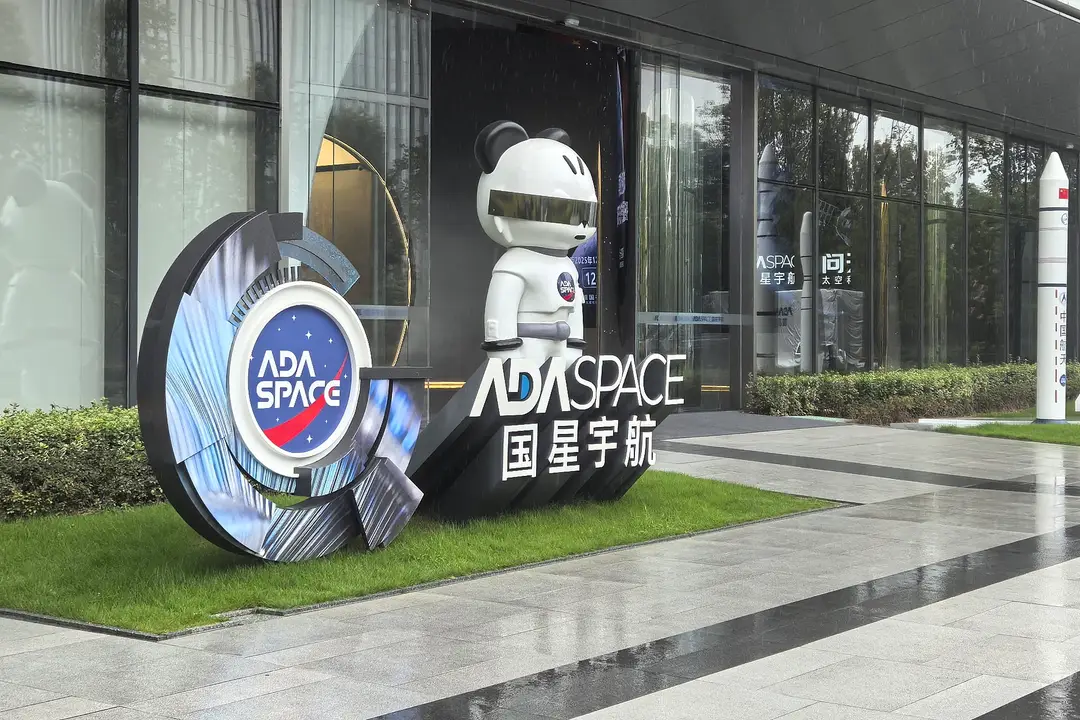
Guoxing Aerospace Technology has passed the Hong Kong Stock Exchange’s main-board listing hearing, according to an update on the bourse’s disclosure website, putting the Chengdu-based commercial space company in the final stage before its IPO and potentially making it the first “space AI” stock in the Hong Kong market. Guotai Junan International is the sole sponsor.
The company, also known as ADA Space, disclosed its post-hearing information pack after three attempts to list. If the remaining process goes smoothly, it could debut on the main board in mid-to-late November.
The latest prospectus shows that as of Oct. 20, Guoxing held orders for 114 AI satellites awaiting delivery, with a total contract value of 3.48 billion yuan ($523 million). In the first half of 2026, its gross margin on satellites and related services reached 53.3%, and operating cash flow turned positive on a net basis. Its space-computing business is moving from technical validation into commercial validation.
Founder retains control with 30.77% of voting rights
Founded in 2018, Guoxing covers AI satellite development, in-orbit telemetry, tracking and control, and satellite-based solutions. It was among China’s earlier commercial space companies to bet on onboard AI computing and space-based intelligent computing.
Lu Chuan, the company’s founder, chairman and executive director, was born in 1983 and has nearly 20 years of research experience in artificial intelligence, aerospace and communications engineering. Lu studied at the University of Electronic Science and Technology of China for his bachelor’s and master’s degrees and worked at the university before founding the company.
In 2019, Lu and the university jointly established the Satellite Industry Technology Research Institute, which describes itself as China’s first AI satellite research body, with Lu as its dean.
Lu controls 30.77% of voting rights through two holding platforms, Beijing Xingrong Aerospace and Beijing New Era Space, making him the single largest shareholder group. Other major shareholders include Galaxy Industry Group with about 5.41%; Hongtai Fund founder Sheng Xitai, who holds about 7.93% through several funds; and Shenzhen Capital Group and Chengdu Dianke.
Guoxing has completed at least eight financing rounds since its founding. In April 2026, on the eve of its third listing filing, it closed a 3.55 billion yuan pre-IPO round at a post-money valuation of 11.55 billion yuan, one of the largest single private financings in China’s commercial satellite sector in recent years.
Revenue mix shifts toward satellites
Guoxing’s path to the hearing took nearly six months from its third submission in May 2026. It first filed in January 2025, updated its materials in August of that year and submitted again in May 2026.
The company remains loss-making. Revenue totaled 508 million yuan in 2023, 553 million yuan in 2024, 703 million yuan in 2025 and 226 million yuan in the first half of 2026.
Net losses over the same periods were 139 million yuan, 177 million yuan, 256 million yuan and 151 million yuan, respectively, bringing cumulative losses over the three full years to more than 572 million yuan.
Its operations are divided into satellite and related services, and satellite-based solutions. The latter was historically the main revenue contributor, generating 444 million yuan in 2025, or 63.2% of total revenue.
But satellite and related services have expanded rapidly. The business accounted for just 0.6% of revenue in 2023, rising to 36.5% in 2025 and 57.7% in the first half of 2026. Satellite services have now overtaken satellite-based solutions as the company’s largest revenue source.
Gross margin fluctuated significantly, reaching 14.0% in 2023, 38.0% in 2024 and 20.4% in 2025. The 2025 margin fell 17.6 percentage points from the previous year.
The company attributed its losses to the early stage of its business, with substantial upfront spending on satellite development and constellation construction, alongside sustained research and development investment. R&D spending totaled 53.48 million yuan in 2023, 142 million yuan in 2024 and 152 million yuan in 2025, exceeding 340 million yuan cumulatively.
Target of 2,800 AI computing satellites
As of Oct. 20, 2026, Guoxing’s order book comprised 114 AI satellites awaiting delivery, with a total contract value of 3.48 billion yuan. On Oct. 14, 2026, the company launched eight “Xingsuan” satellites aboard a Zhuque-2 improved rocket, advancing its constellation build-out.
The Xingsuan plan ultimately calls for 2,800 AI computing satellites designed to run large models directly in orbit, creating a space-native computing network intended to overcome the bandwidth limits of conventional remote-sensing satellite data downlinks.
By 2025 revenue, Guoxing ranked second among Chinese private commercial space companies covering the full satellite value chain, according to Frost & Sullivan.
Guoxing’s clearance comes as capital-market activity accelerates across China’s commercial space sector. Rocket makers including LandSpace and Zhongke Aerospace, also known as CAS Space, are in filing or inquiry stages for the Shanghai Stock Exchange’s STAR Market, while satellite manufacturing and operations companies have generally chosen Hong Kong for listings.
A commercial space investor told the STAR Market Daily that a Hong Kong listing would open financing channels and subject Guoxing’s space computing business model to public-market scrutiny. Chinese commercial satellite companies commonly face large constellation-construction costs, long payback periods and underdeveloped downstream applications, the investor said, adding that high customer concentration, launch-failure risk and slower-than-expected technology iteration are also sector-wide risks.
Under typical Hong Kong IPO timelines, companies that pass the hearing usually proceed to roadshows and public offering within two to three weeks and complete listing if market conditions remain stable. That would put Guoxing’s main-board debut in mid-to-late November 2026.
Source:
STAR Market Daily