

The Chinese AI developer says its V4.1-Flash-1017 update delivers better results at lower cost, and releases a chart to prove it.
By Zhao Yunfan
DeepSeek has long declined to confirm it, but the AI developer community has treated the company’s aggressively priced models as the kill line for rivals. Now the start-up itself appears to be embracing that reputation.
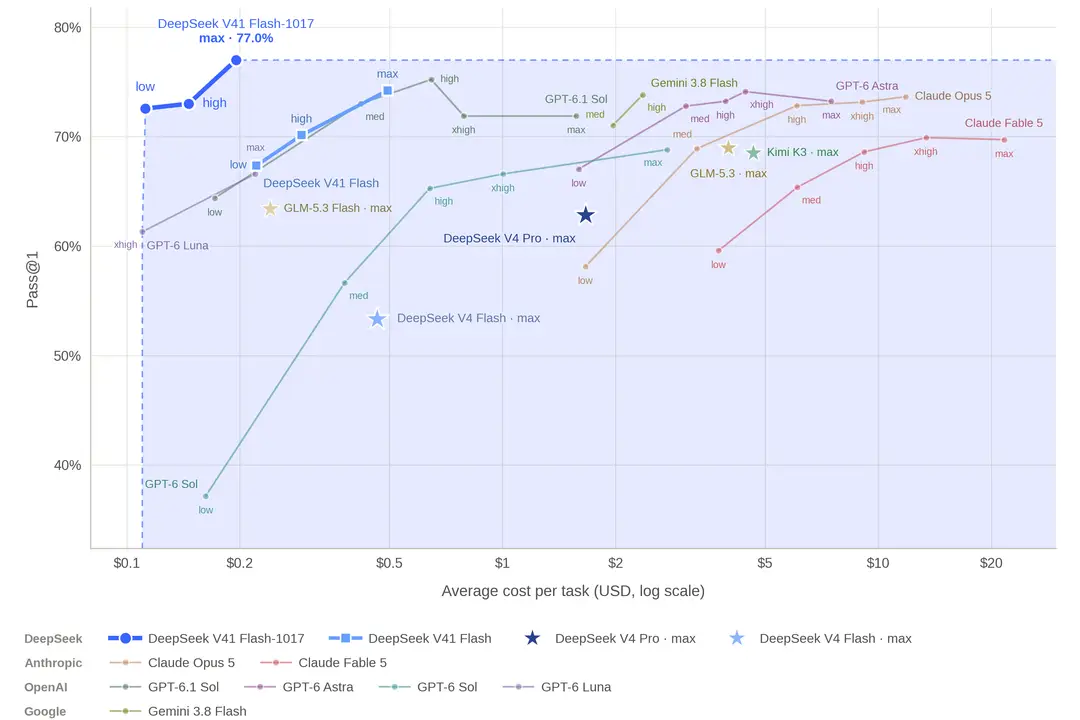
On Oct. 17, DeepSeek announced the V4.1-Flash-1017 update. Unlike past releases heavy on technical and engineering exposition, the company proudly declared the new version achieved a Pareto improvement and released a scatter plot comparing benchmark costs, implying its price-performance ratio leaves competitors “in the dust.”
It may be the closest DeepSeek has come to officially acknowledging its status as the industry’s kill line — gamer shorthand for the threshold at which a rival is effectively finished, and now developer slang for the price point at which DeepSeek’s models make competitors’ higher prices hard to justify.
A combative Pareto Improvement
Pareto improvement is a basic concept in welfare economics: a change that raises overall social welfare without making any participant worse off. Applied to large models, it suggests all use cases improved without any increase in cost. This is the first time DeepSeek has promoted its model in official literature as achieving a Pareto improvement.
Paired with Pareto improvement is Pareto optimality — an allocation that represents the optimal solution for social welfare among all possible distributions. In this release, the well-known Chinese open-source model company is clearly positioning itself as one of those optimal solutions.
In its announcement, V4.1-Flash-1017 aggressively pulled the most widely used and representative models into the benchmark arena: Moonshot AI‘s Kimi K3, the GLM5.3 model of Z.AI (Zhipu) (2513.HK), OpenAI‘s GPT5.6 and Anthropic‘s Claude Opus 5. According to DeepSeek’s own testing, V4.1-Flash-1017 took first place in four of 11 agent benchmark tests.
But that is not the core of the release. What the company really wants to convey is hidden in the scatter plot.
The “price versus benchmark pass rate” chart includes more top-tier models that have held state-of-the-art (SOTA) status, including the newly released GPT-6 series Astra, Luna and 6.1Sol, and Claude Fable 5. Models are plotted by how often they complete benchmark tasks correctly — what’s known as the pass rate — and how many tokens they consume at different usage intensities,
The further left, the cheaper the model; the further up, the better the performance. Models closer to the top-left corner offer higher cost-effectiveness; those toward the bottom-right lack market competitiveness.
In DeepSeek’s own benchmark, V4.1-Flash-1017 sits high in the top-left — the cheap, easy-to-use Pareto optimum. Its slope across usage intensities is significantly lower than rivals’, indicating strong usability and cost-effectiveness even in low-intensity modes. Implicitly, DeepSeek appears to be answering its kill line nickname.
“This chart will probably go viral for a while. DeepSeek wants to deepen everyone’s impression of the company this way, even if nobody fully accepts the data on it,” one AI algorithm engineer commented on social media.
Locking in cost-effectiveness, aiming for ‘Inclusive AI’
Developer reaction to DeepSeek’s self-praise and its implicit jab at frontier models’ lack of price advantage has been mixed. Some developers tested the model and found DeepSeek genuinely delivers flagship work at a fraction of the cost; some independent OPC (OpenCode) tests — independent tests run through the OpenCode tool — showed development costs cut to one-half or even one-third of frontier models.
On Oct. 19, well-known AI gateway Vercel AI released its latest gateway index: in September, DeepSeek models processed 58% of tokens on the platform but accounted for only 6.6% of total costs. The V4.1-Flash model alone consumed 50% of tokens while accounting for just 2.6% of costs.
Skepticism remains. Some developers found that on difficult tasks, high-intensity use of DeepSeek not only fails to complete the job perfectly but can cost more than SOTA models such as GPT-6 and Fable. Others assert DeepSeek is dumbing down older model versions to make the new one look smarter. Last week, DeepSeek suffered its longest outage ever, and users report the new V4.1-Flash-1017 still stutters badly.
Still, if DeepSeek’s goal was to reinforce its cost-effectiveness positioning, it appears to have succeeded again. The release promoted the model’s ability to support what it calls wish-based programming — allowing users to describe what they want in natural language and have the AI generate the code. Users report that it performs well on relatively simple, self-contained tasks, such as building a basic game or a functional demonstration. But developers say it struggles with enterprise-grade and system-level programming.
That touches on an industry-wide recognition: DeepSeek’s coding capability still has a clear gap with current SOTA models in practical engineering usability. Yet while Anthropic and OpenAI won over programmers this year with frontier coding ability, ordinary users’ downstream demand to build automated AI assistants through AI programming remains genuinely unmet — developing a usable piece of software requires multiple rounds of debugging, and the hidden development costs far exceed one or two conversations.
For DeepSeek, which is nearing completion of a new funding round and has set its sights on an IPO, locking in the largest possible user base through low-cost access — and building a broad model-usage ecosystem — is key to anchoring its valuation.
Affordable and accessible
On Oct. 20, DeepSeek announced it would fully open-source its inference framework DeepInfer, which is used to run trained AI models and generate responses. The company said it hopes that sharing internal deployment experience will help developers and enterprises optimize throughput — the volume of requests a system can handle — and latency, the time it takes to respond. The aim is to make large-scale inference more efficient across private and public cloud deployments, cut computing costs and energy consumption, and deliver intelligence to more people at lower prices.
DeepSeek framed the move as part of its ambition to make AI genuinely accessible to a wider population. The strategy reinforces the company’s focus on affordability. Its latest model may not match the leaders on every demanding task, but DeepSeek is betting that low costs and broad accessibility can be just as important as absolute performance in building a lasting position in the AI market.
Source:
21st Century Business Herald