
The Qianfan satellite network is nearing its first commercial milestone, but launch capacity, customer demand and revenue remain significant challenges.
By Zheng Chenye
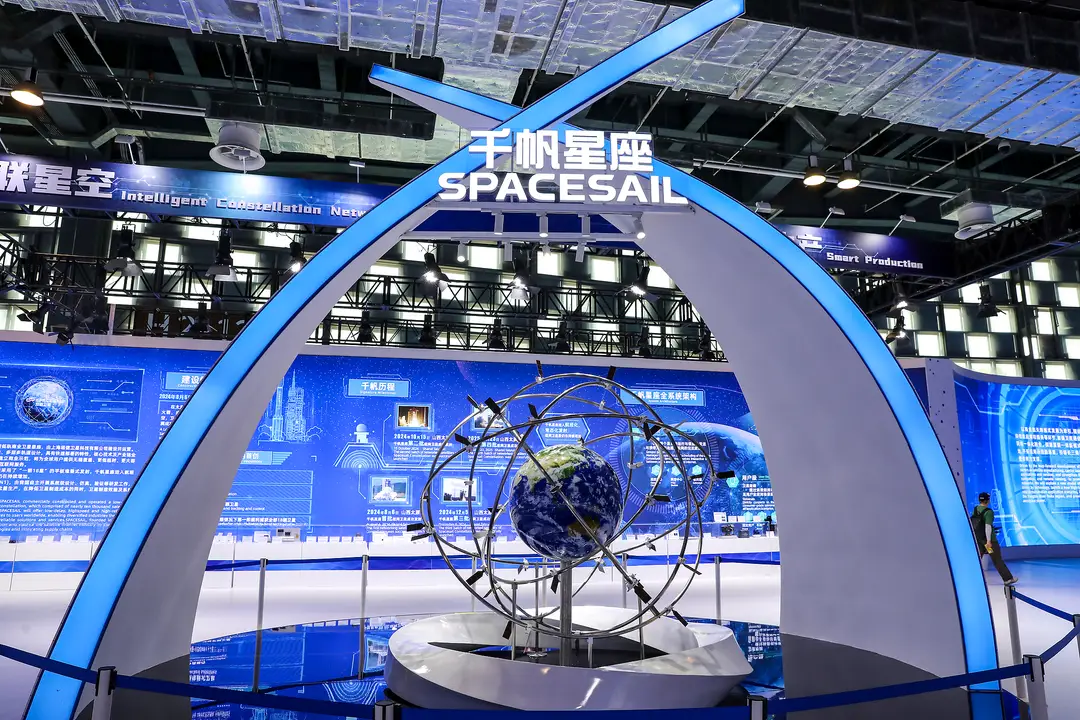
China’s Qianfan (Thousand Sails) low-Earth-orbit (LEO) satellite constellation is approaching commercial launch, but its year-end target of 324 satellites remains just out of reach. Even if it gets there, the network, marketed internationally as SpaceSail, faces bigger challenges: securing customers, obtaining operating licences and generating revenue.
On Nov. 3, a Lijian-2 rocket launched 18 Qianfan satellites from Jiuquan, bringing the constellation’s total in orbit to 274. Operator Shanghai Spacecom Satellite Technology (SSST), known in Chinese as Shanghai Yuanxin Satellite Technology, needs another 50 satellites to meet its first-stage target, announced for year-end. At least three more launches will be required.
Other preparations are advancing. Qianfan satellites have received batches of radio station licences and frequency permits, SSST completed a 6.98 billion yuan ($1.05 billion) capital increase in August, and its user terminal received Brazilian regulatory certification on Oct. 19.
But ordinary Chinese consumers cannot yet access the service. Brazil is the most advanced overseas market, where Qianfan is preparing to compete with SpaceX’s Starlink, which began commercial operations in 2020.
“Launching satellites solves the problem of whether capacity exists. Commercialisation means answering who will buy that capacity and how much can be sold,” an investor following China’s commercial space industry told Economic Observer.
Launch capacity remains a bottleneck
The 324-satellite threshold will provide basic global coverage and allow SSST to offer initial commercial services. But the longer-term ambition is much larger. The original plan called for 648 satellites to be deployed by the end of 2025, yet only 108 were in orbit by that deadline.
Launch capacity is a major constraint. SSST Chairman Zhang Qi said in March that large-payload, low-cost reusable rockets were still at the testing stage, while launch and tracking resources remained insufficient for rapid constellation deployment.
An analyst at a major southern Chinese securities firm said commercial launch facilities were operating at a much higher frequency than last year, with two launches a month from individual pads becoming commonplace. Three a month could become possible next year.
However, launch schedules at major facilities are largely booked through 2027, and new rocket models typically require two to three months of preparation before their first launch.
The challenge extends beyond Qianfan. Both it and the GW constellation being developed by state-owned China SatNet (China Satellite Network Group) envisage more than 10,000 satellites. Under International Telecommunication Union rules, constellations that miss deployment deadlines risk losing allocated frequency and orbital resources.
One analyst estimates China will launch 400 to 500 satellites this year, rising to 800 to 1,000 in 2027. Geng Jiashuai, managing director of Wanchuang Investment Bank, said 2027 and 2028 would be critical years for expanding launch capacity.
Overseas customers come first
Overseas markets are further advanced than China in preparing for commercial services. LEO satellites spend much of their time outside Chinese territory, making international customers essential to generating sufficient revenue.
Domestic consumers also face three barriers: access to direct-to-phone satellite connections, affordable terminals, and the necessary telecommunications operating licences.
SSST launched its first experimental direct-to-phone satellite in June and demonstrated voice and video calls using an unmodified 5G handset. However, no commercial launch date has been announced. China’s telecom operators are expected to play the leading role in providing mass-market mobile satellite services.
For users without direct-to-phone access, dedicated terminals will be necessary. SSST unveiled its first Qianfan terminal in June but has not disclosed its price. An investor said lower costs would depend on mass production of specialised chips, with limited shipments expected in the first half of 2027 and larger-scale production in 2028.
For now, domestic demand is concentrated in aviation, maritime transport and remote energy and mining projects, where terrestrial network coverage is limited and customers have greater purchasing power.
SSST has signed agreements with Airbus to integrate Qianfan services into in-flight connectivity solutions and with China Communications Construction Shanghai Dredging for remote dredging and marine surveying. Neither partnership has announced a launch date.
Brazil is further ahead. Qianfan’s operating application was approved in February, and its ground stations have completed commissioning. Its certified user terminal weighs about 4kg and supports download speeds of up to 400Mbps. SSST originally planned to launch commercial services in the fourth quarter, although pricing and an exact date remain undisclosed.
Other Chinese satellite companies are also testing overseas markets. GalaxySpace completed its first application test in Indonesia in November, working with a local telecommunications provider.
Starlink provides a commercial template
For Chinese operators, Starlink is both a competitor and a useful precedent. SpaceX reported approximately 9,600 satellites in orbit at the end of March. By September, Starlink covered 174 markets and had 13.6 million consumer customers, adding 1.6 million in the third quarter.
Its experience has helped demonstrate demand in markets such as Brazil, where Anatel recorded 936,800 Starlink fixed broadband connections in August. The network has also established a regulatory precedent for foreign satellite operators.
Starlink has demonstrated the potential economics of the business, too. Its connectivity operations generated $5.248 billion in third-quarter revenue, up 69% year on year, and operating profit of $2.367 billion.
But Chinese operators must still build their own commercial operations country by country, securing frequency coordination, licences, ground stations and local partners. SSST’s financial disclosures show just 1.15 million yuan in revenue in 2024 and zero revenue in the first 11 months of 2025, alongside substantial losses.
Satellites also need replacing. Qianfan’s individual satellites now cost just over 10 million yuan and have a designed operating life of seven years, according to SSST’s chief system architect Hu Haiying.
The potential market remains substantial. The International Telecommunication Union estimated that 2.2 billion people worldwide still lacked internet access, many in areas beyond the reach of terrestrial networks.
For China’s satellite operators, the opportunity is clear. Turning that potential into paying customers and sustainable revenue will be the harder part.
Source:
Economic Observer