
By Da Cheung
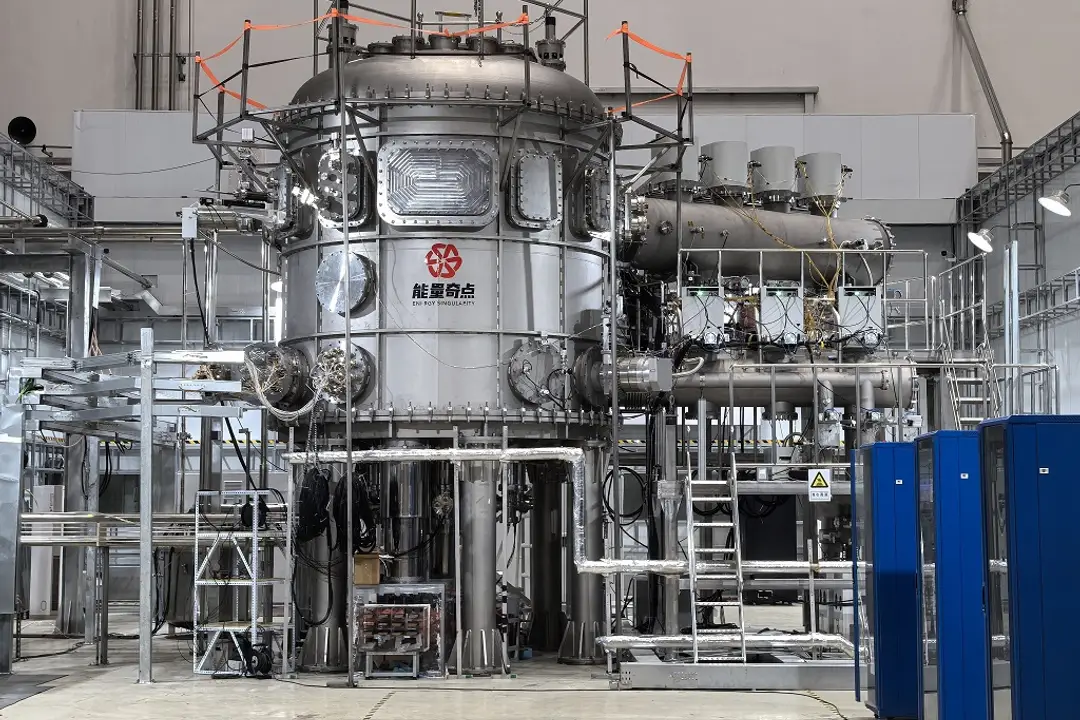
On Wednesday, a Shanghai-based startup backed by Chinese video game developer miHoYo, announced a major milestone in the quest for almost limitless, clean energy. Energy Singularity, a developer of commercial nuclear fusion energy, claimed it had successfully sustained a steady-state plasma operation for 1,337 seconds.
This breaks the previous 100-second ceiling for commercial fusion enterprises, according to the company. The record was set using “Honghuang 70,” which the company claims is the world’s first fully high-temperature superconducting (HTS) tokamak.
A tokamak is a doughnut-shaped machine that uses powerful magnets to create a “magnetic cage.” This cage confines plasma — a super-heated, charged cloud of gas — at extreme temperatures approaching 50 million degrees Celsius, forcing atomic nuclei to fuse and release immense energy. Traditional fusion reactors rely on low-temperature superconducting materials, requiring massive and incredibly expensive infrastructure. In contrast, HTS materials can generate stronger magnetic fields in much smaller footprints, dramatically shrinking the size of a reactor and potentially accelerating the path to commercialization.
Fusion relies on fuels like deuterium, which can be extracted endlessly from seawater. With zero greenhouse gas emissions and no long-lived high-level radioactive waste, a successful commercial rollout could fundamentally solve the global energy crisis — if the engineering and physics challenges can eventually be overcome.
Chasing net energy gain
While the 1,337-second run proves the engineering stability of the HTS approach under extreme conditions, achieving a commercially viable power plant remains a hurdle.
A key metric in the fusion industry is the Q value, which measures net energy gain — the ratio of energy a reactor outputs compared to the energy required to power it. A Q value of 1 indicates breakeven, while a value greater than 10 is considered necessary for a commercial power plant.
Currently, the U.S.-based National Ignition Facility (NIF) operates the only system in the world to have demonstrated a net energy gain at the target level, producing more energy than delivered to its target by lasers. However, this net-positive output can only be maintained for a few nanoseconds. Because no other fusion projects have broken even, and the only successful reaction is overwhelmingly fleeting, humanity is still far away from a commercially sustainable fusion reactor.
Despite these daunting scientific hurdles, Energy Singularity says it is currently integrating artificial intelligence algorithms to upgrade its plasma control and diagnostic equipment, aiming for even longer runs and clearer temperature data later this year. It is also designing its next-generation device, the “Honghuang 170,” which it plans to build by 2028. The company says it hopes to achieve a Q value greater than 2 within the next three years, potentially making it the first Chinese device to reach this critical commercial milestone, Yicai reported.
A global race fueled by billions
The breakthrough comes amid a massive influx of capital into the global fusion sector. Private funding of fusion projects reached $10.6 billion between 2021 and 2025, with the number of fusion companies more than doubling, according to the World Economic Forum.
Competitors worldwide are rapidly advancing. In the United States, alongside the NIF’s achievements, several companies are aggressively pursuing commercialization. One is Commonwealth Fusion Systems, backed by nearly $3 billion from investors including Google, and another is Helion, which plans to supply power to Microsoft by 2028. In Germany, the Wendelstein 7-X stellarator generated 1.8 gigajoules of plasma energy turnover in May 2025.
China has heavily prioritized the sector, spending an estimated $1.5 billion annually on fusion research — nearly double the U.S. government’s 2024 allocation, according to Nature and the Financial Times.
China’s accelerating fusion ecosystem
To consolidate its efforts, China is cultivating a robust domestic supply chain. In July 2025, a state-led consortium established China Fusion Energy Inc. with a joint investment of 11.5 billion yuan ($1.6 billion), aiming to push fusion from scientific exploration to industrialization. According to Duan Xuru, chief scientist of the fusion domain at China National Nuclear Corporation, the country expects to build an engineering experimental reactor by around 2035 and a commercial demonstration reactor by 2045.
In addition to state-owned companies and labs, private venture capital is also rushing into Shanghai’s Lingang Special Area. Energy Singularity, which completed a Series A funding round in February following roughly 800 million yuan in earlier rounds, is just one player. NovaFusion recently raised 500 million yuan in angel funding, while Dongsheng Fusion is developing alternative fuel technologies.
Sources: