

By Brent Li
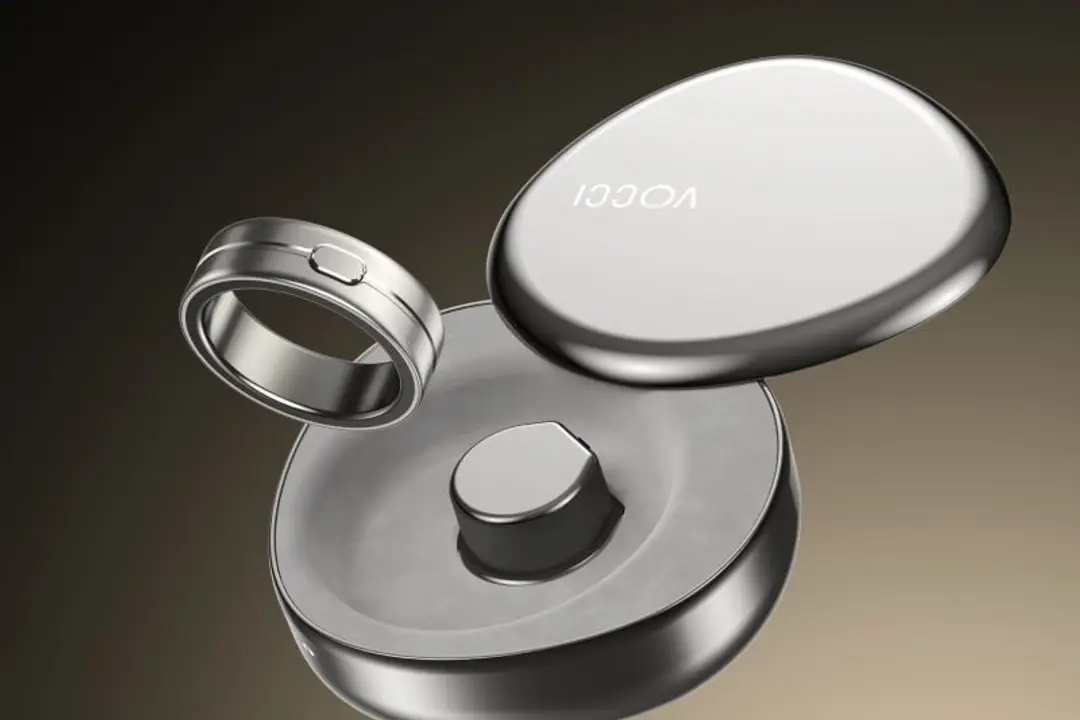
Artificial intelligence has already conquered our screens; now, it wants a permanent seat on your hand. Hardware startup Gyges Labs is moving beyond simple fitness tracking with the global pre-sale of the Vocci Ring, a smart ring designed to act as a dedicated hub connecting users to their digital AI ecosystem.
The device is positioned as the “shortest path” for interacting with AI services, offering voice-controlled productivity tools for professionals. On social media, influencers have already begun hyping the device with lofty claims of “putting OpenClaw into a ring” — capitalizing on the frenzy surrounding the OpenClaw AI agent in China. However, the reality is more utilitarian: the ring primarily serves as a convenient input and feedback interface for cloud-based AI services, rather than running complex autonomous software natively on the hardware.
Shifts in the wearable battleground
The global smart ring market is currently dominated by health and fitness trackers, with Oura and its Oura Ring holding a 74% share as of late 2025, according to an Informa report. Tech giant Samsung’s Galaxy Ring is among a plethora of such products that are heavily focused on health monitoring.
Gyges Labs is attempting to bypass these established leaders by carving out an entirely new vertical. The Vocci Ring intentionally abandons heart rate and sleep sensors, pivoting instead to acoustic interaction and productivity.
Aimed at lawyers, journalists, and finance professionals, the device is marketed as “professional jewelry” rather than a geeky gadget. The titanium ring features a double-tap gesture to trigger recording, a single tap to bookmark key moments, and a five-meter audio pickup range. It boasts eight hours of standalone recording and transcription support for 112 languages.
The company claims the ring links to a proprietary AI agent architecture designed to automatically structure notes, extract insights, and execute workflows on a connected computer. Recognizing the sensitivity of recording devices in business environments, the startup is seeking compliance with GDPR and SOC 2 data security standards, according to 36kr. Gyges Labs plans to target the European and U.S. markets first, citing mature software workflows and a higher consumer willingness to pay for efficiency tools.
The search for the right AI vessel
As AI agents increasingly integrate into daily life and work, manufacturers are rushing to build the physical vessels to house them. However, products in this space require scrutiny. We have already seen camera-equipped smart earbuds try—and largely fail—to capture this same market.
Ultimately, an “AI ring” is an input/output interface. By this logic, any microphone or keyboard could declare itself an “AI product” simply because it enables access to a service.
Gyges Labs has deployed a similar strategy before. In 2025, it launched the Halliday Glasses, a wearable that raised over $3.3 million on Kickstarter. Despite backing from high-profile investors like GSR Ventures and Granite Asia, the company appears to have quietly abandoned the eyewear sector, according to Liangziwei.
While Gyges says the Vocci Ring was built on insights from 15,000 delivered pairs of glasses, the Halliday frames are now virtually impossible to find on mainstream e-commerce platforms. A few third-party stores list them at steep prices (upwards of $550), but sales records show almost zero consumer traction.
Waiting for the ‘iPhone moment’
Wearables like rings, earbuds, and glasses undoubtedly offer advantages in usability and are less intrusive when compared with traditional screens and keyboards. In a 2025 interview with Liangziwei, Gyges Labs executive Deng Xudong argued that the smartphone’s biggest disadvantage is occupying the user’s hands. “Wearables… can truly perceive what I perceive, offering 24-hour companionship,” he noted.
His logic is sound, but the company’s abrupt shift from glasses to rings reveals why this vision remains elusive: current technology still cannot make smart glasses as lightweight as ordinary eyewear without severely compromising utility.
Many startups proclaim that the “iPhone moment” for their sector has arrived. But in reality, consumers will need to be patient. For wearables to truly revolutionize computing, significant breakthroughs in miniaturization and battery capacity are still required. As companies flood the market with hardware, it’s possible that the dominant AI device of the future is something we haven’t even imagined yet.
Sources