
By Da Cheung
For years, German automaker Volkswagen (VW) was one of the industry’s staunches advocates of pure electric vehicles. A former VW China CEO once publicly dismissed range-extended technology, basically hybrid cars that mix batteries with gasoline engines as a mere transition. However, facing a rapidly evolving landscape, the company has done a U-turn.
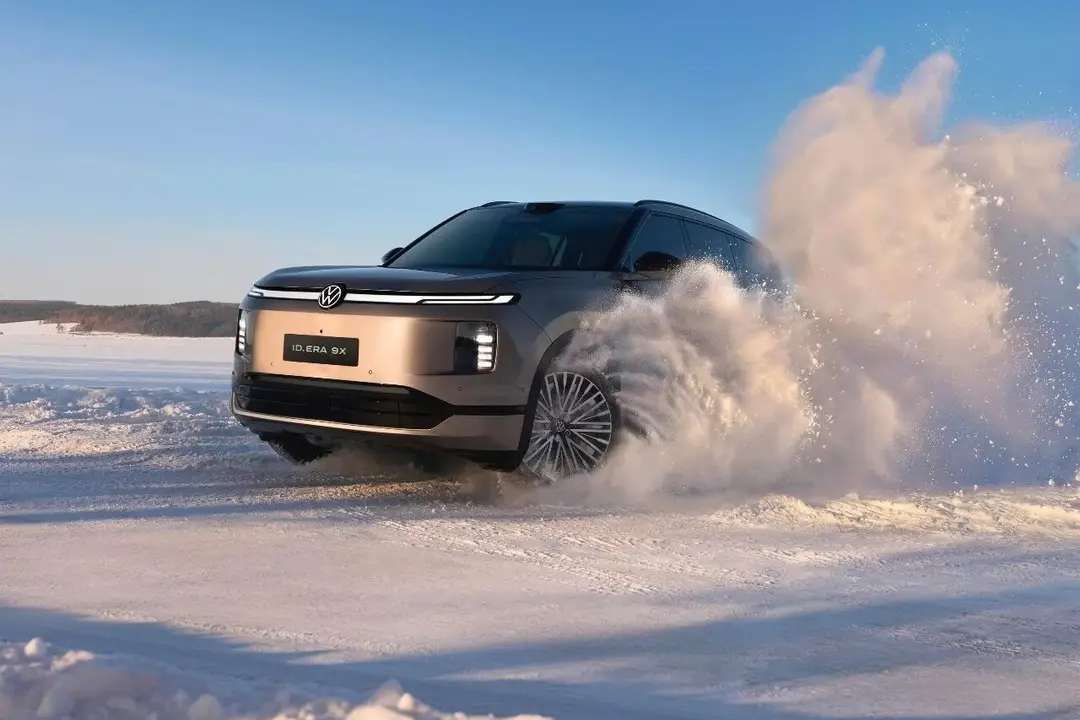
On March 16, SAIC Volkswagen — the company’s first joint venture in China — unveiled the ID. ERA 9X. The flagship SUV is the brand’s first range-extended electric vehicle (REEV). Unlike battery electric vehicles (BEVs) that rely solely on plug-in charging, REEVs are equipped with an internal combustion engine (ICE) that acts purely as a generator to charge the battery, mitigating range-anxiety for drivers making long cross-country trips.
To power the generator, VW repurposed one of its ICEs that had racked up over 10 million global installations. By adapting mature technology into a modern hybrid system, the company is effectively squeezing the last drop of value from its vast technology reserves.
The vehicle also reflects international brands’ growing reliance on domestic software. The ID. ERA 9X features an autonomous driving solution from Momenta, a leading Chinese software provider. The system uses an AI world model — a technology that learns the physical rules of the real world to handle unpredictable driving scenarios such as pedestrians suddenly stepping out into the road. The partnership highlights a broader trend: Western automakers, struggling to compete with domestic brands in software development, are increasingly defining and developing new products entirely in China for global distribution.
SAIC Volkswagen aims to launch seven new electrified models in China this year, part of an aggressive push to increase its NEV sales from 5% to over 20% of its total by the end of 2026.
The fading blue ocean and a pioneer’s stumble
The year 2025 marked a watershed moment for NEVs, China’s catch-all term for plug-ins and EVs. Sales surpassed traditional ICE cars for the first time to capture 51.8% of the market, with 16.49 million units sold. BEV sales saw the biggest increase, jumping 17.5%. While REEVs grew by a more modest 5.8% to 1.235 million units, the segment remains highly lucrative. For a giant like VW, tapping into this sub-market opens up access to nearly 10% of what has become the world’s largest EV market.
Yet, just as VW is entering the fray, the very company that popularized the REEV niche in China is faltering. Li Auto carved out a highly profitable market catering to families with large, range-extended SUVs equipped with premium amenities, while most other domestic startups bet entirely on BEVs.
However, as pure EV technology improved with faster charging and cheaper batteries, the unique advantages of REEVs began to dilute. Attempting to adapt, Li Auto launched its own premium BEV, but the pivot proved costly. Its 2025 financial report showed overall net profit collapsed 85.8% to 1.139 billion yuan ($158 million). Deliveries fell 18.8% to 406,300 units, pushing the company’s core automotive operating business into a net loss of 521 million yuan.
A crowded battlefield
The competitive landscape is becoming increasingly ruthless. The REEV niche is now heavily crowded, with nearly 50 models battling for the market in 2025.
The toughest REEV competitor for both VW and Li Auto is arguably Aito, a brand co-developed by tech giant Huawei and privately owned vehicle group Seres. Its M7 and M9 models successfully feature both BEV and REEV powertrains and have made a significant dent in Li Auto’s market share. Furthermore, domestic heavyweights such as Xpeng, Xiaomi, and BYD are reportedly preparing to flood the market with their own REEV products featuring larger battery packs.
As battery costs continue to plummet and charging infrastructure expands, the REEV powertrain could ultimately prove to be a temporal choice in the broader evolution of the EV world. For now, the industry is watching closely to see how legacy titans and embattled startups navigate what could be a lucrative, yet potentially short, chapter in automotive history.
Sources: