
By Da Cheung
In a bustling Seoul fast-food joint, the cook stationed by the 200-degree Celsius deep fryer never sweats, complains, or asks for a raise. That’s because it’s no human, but a robotic arm. Thousands of miles away in Hangzhou, China, a 74-year-old woman asks her “personal secretary” for a banana, and a mechanical arm attached to her smart wheelchair obliges.
For decades, service robots were widely dismissed as clumsy marketing gimmicks. But a recent flurry of deployments and capital injections suggests the industry is undergoing a quiet transformation. Driven by post-pandemic inflation and severe labor shortages in the West, as well as an aging population in China, tech startups are moving away from showy displays. Instead, they are doubling down on hyper-specialized “embodied AI” — artificial intelligence systems integrated into physical structures, allowing robots to perceive, learn from, and physically manipulate their real-world environments.
The domestic market is forecast to grow strongly. A 2026 report by NCBD, a catering data firm, estimates the market for commercial stir-fry robots was 3.81 billion yuan ($529.1million) in 2025 and could hit 12.5 billion yuan by 2030.
Redefining the automated kitchen
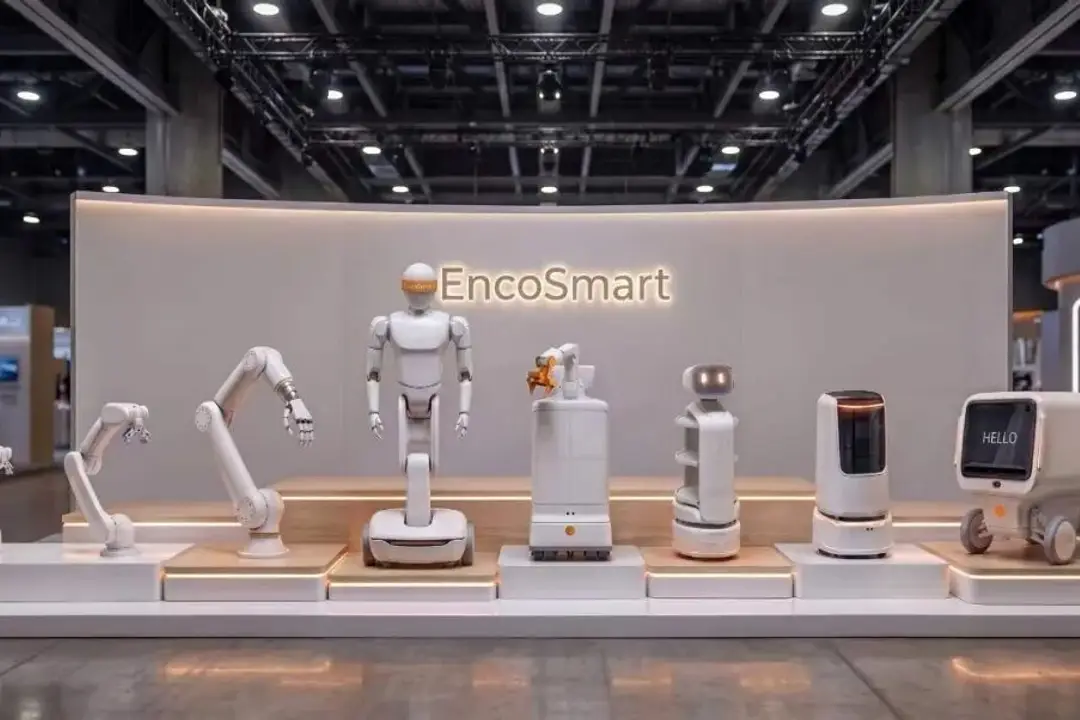
Growing investor interest in specialized service robots was evident this week. On April 14, Beijing-based startup EncoSmart announced a 150 million yuan Series A funding round led by electric-scooter maker Ninebot, which bought U.S. two-wheeler scooter brand Segway in 2015, bringing its total financing to nearly 300 million yuan.
Unlike general-purpose humanoid robots, which still struggle with real-world complexities, commercial success currently hinges on extreme specialization. EncoSmart’s LAVA robot focuses entirely on deep-frying. Equipped with cameras and an AI model trained specifically on culinary data, it visually inspects food and monitors oil quality, the company says.
There is a strong economic imperative driving this adoption. The labor gap in Western service industries has made restaurant automation more compelling. By leveraging its investor’s established global distribution channels, EncoSmart expects up to half of its future revenue to come from overseas, where deep-fried food is a dietary staple. The company used this year’s spring Canton Fair, currently underway in Guangzhou, to unveil Nico, a new humanoid robot pitched as a cross-scenario worker capable of both back-of-house and front-desk tasks.
Beyond the gimmick
The concept of an automated restaurant has weathered a long boom-and-bust cycle. According to the Zhongguancun Industry Research Institute, the sector experienced a brief explosion around 2012, flooded with rigid, track-bound machines that functioned mostly as novelties. The majority of those early ventures failed due to high maintenance costs.
A turning point came in 2018 when large food and retail chains like Freshippo and Haidilao began integrating more flexible, trackless delivery robots to counter rising operating costs. By 2025, Tesla had piloted automated diner concepts in California, proving the model’s viability. Today, the focus has shifted firmly to operational efficiency.
Fully automated kitchens are still some way off, however. In several community canteens in Hangzhou, robots currently handle over 60% of the cooking workload, according to City Express. A single human chef can oversee two automated woks that cost a combined 120,000 yuan — roughly the annual salary of one human cook. However, these machines still rely heavily on humans to prep ingredients, portion meals, and perform the tedious task of cleaning greasy pans. Engineers note that transitioning these machines from commercial kitchens into private homes will require significant downsizing and cost reductions, a milestone still three to five years away.
The silver economy’s metal helpers
While the catering industry seeks efficiency, the eldercare sector is searching for a lifeline. Amid growing concern about the strains an aging population will impose on the country’s economic and social fabric, the Chinese government recently launched a pilot program to integrate smart robots into nursing homes and communities by 2027.
In a Hangzhou nursing home, a smart wheelchair named Huibao has been operating since late 2025. Equipped with a six-axis robotic arm and depth-sensing cameras, the wheelchair can fetch objects or press elevator buttons based on voice commands.
But just like in the kitchen, the integration is not seamless. The robot occasionally misjudges complex shapes — dropping a television remote during one trial. High costs also remain a formidable barrier. The current prototype is priced at around 200,000 yuan, limiting adoption to well-funded institutions. Developers say they are currently optimizing costs and introducing softer, dexterous hands to handle delicate items like medicine packets.
The current generation of robotics is not about completely replacing humans, but filling the structural gaps they leave behind. As EncoSmart’s founder Chen Zhen noted to FastCarp, a successful robot should not be bound by its futuristic appearance, but by the practical demands of the environment it serves.
Sources: