
By Stone Jin
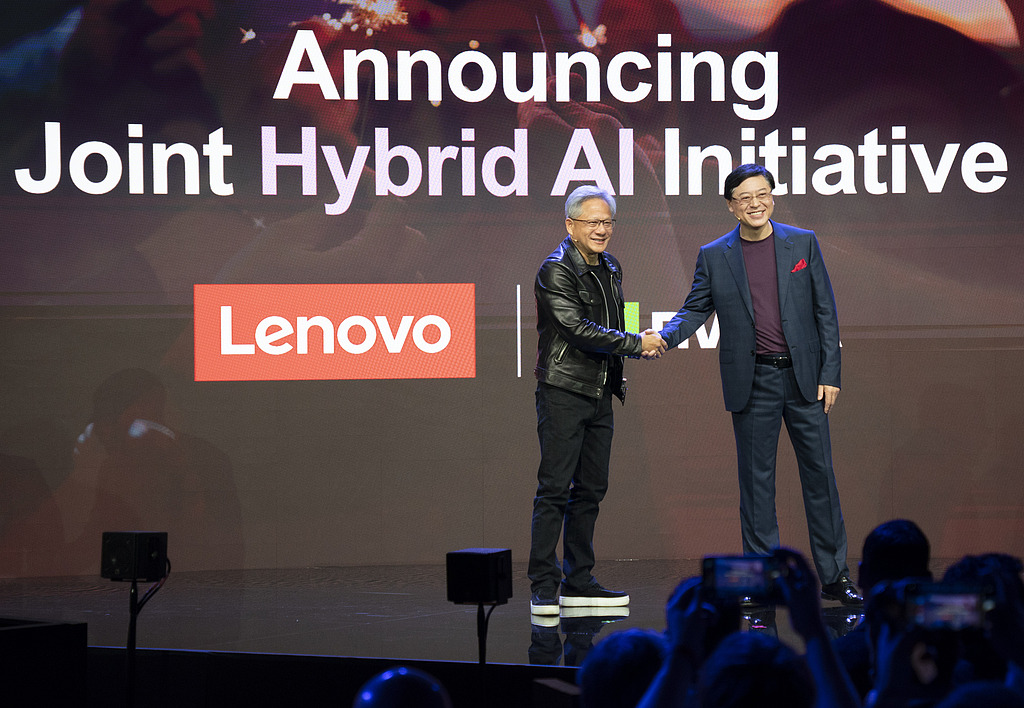
Jensen Huang, CEO of Nvidia (NVDA.US), shared a high-stakes prediction with Yang Yuanqing, chairman and CEO of Lenovo Group (0992.HK) (LNVGY), on March 16 at the Nvidia GTC exhibition area in San Jose, California. “This is gonna be your year! I feel it,” Huang told Yang.
In response, Yang noted, “Our business segments are very strong—stronger than ever before.” Huang replied enthusiastically, “That’s great! Very strong. We did it!”
This brief but intense exchange between the two tech titans reflects a pivotal shift in the global AI industry: AI is irreversibly moving from the costly “model training” phase into an era of “real-time inference” and large-scale industrial production.
At GTC 2026, Lenovo and Nvidia jointly unveiled the next-generation Lenovo Hybrid AI Advantage solution suite, which is designed to accelerate AI implementation, reduce time to first token, and deliver measurable business outcomes across individual, enterprise, and cloud environments.
Lenovo’s updated hybrid AI solutions span from edge devices to data centers and up to gigawatt-scale AI cloud infrastructure, enabling real-time decision-making, improved operational efficiency, and intelligent automation at scale. Yang emphasized that as agentic AI drives exponential growth in inference workloads, cost control and per-token performance will become critical factors.
Powering the era of agentic AI
Furthermore, at this year’s GTC, Lenovo was officially named a global launch partner for Nvidia’s Vera Rubin NVL72 system. Compared with the previous generation, Vera Rubin delivers up to a tenfold increase in throughput while reducing the cost per token to one-tenth of its predecessor’s levels, facilitating faster deployment at significantly lower costs.
The launch of the Vera Rubin platform signals the arrival of the Agentic AI era, triggering what is likely to be the largest infrastructure build-out in the history of computing. In his keynote speech, Huang described Vera Rubin as a “generational leap” designed to power every stage of AI development.
Huang pointed out that the next inflection point in AI will significantly increase demand for accelerated computing, software, and AI factories. Lenovo and Nvidia are working together to provide a full-stack platform to support this next phase. Yang added that by integrating Nvidia AI Enterprise software with Lenovo’s full-stack hybrid AI platforms and services, Lenovo can help customers scale AI applications more efficiently, reduce per-token costs, and accelerate time-to-market.
Next-generation hardware and developer tools
The two companies are also advancing the global deployment of tangible AI productivity through next-generation AI inference platforms, AI cloud super-factories, and industry-specific Agentic AI solutions.
Separately, Huang left his signature—J. Huang WAS HERE — on Lenovo’s Project Kubit, a personal AI Hub concept device. Featuring a transparent touch screen, the device integrates two ThinkStation PGX AI workstations powered by the Nvidia GB10 Grace Blackwell superchip. It is designed to consolidate data across PCs, smartphones, wearables, and smart home devices to run AI applications locally.
The ThinkStation PGX, one of Lenovo’s flagship announcements at GTC, is a next-generation AI workstation aimed at AI developers. It supports AI models with up to 200 billion parameters and delivers as much as one petaflop of AI compute power, enabling secure, private, and on-premises AI development and inference.
Lenovo also introduced a full-stack AI Developer toolkit and reference architecture to help data scientists and developers build, scale, and secure their AI workflows.
Source:
IPO Early News