
By Li Su
At 7:30 a.m., as the first light of dawn filters through the curtains of a high-rise apartment in Beijing’s Chaoyang District, a soft, synthesized voice breaks the silence. “Good morning. There is light smog today; I suggest you wear your light gray trench coat. Breakfast is ready, and the coffee is on the table. Please enjoy it while it’s hot.”
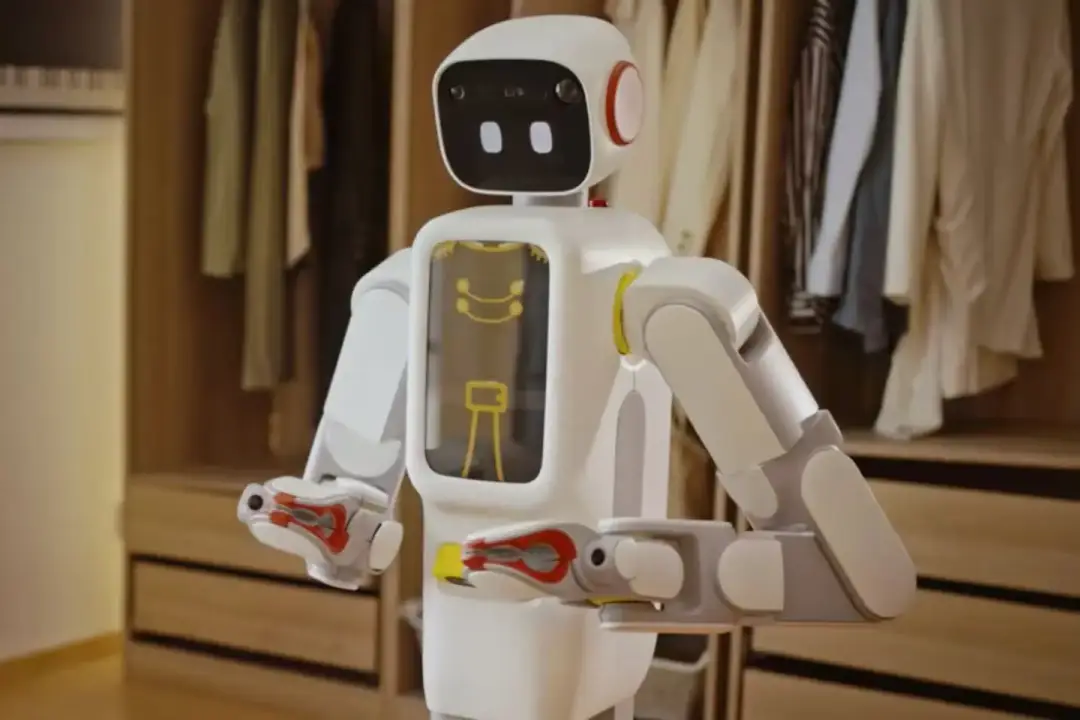
This isn’t the greeting of a high-end butler or a scene from a Hollywood sci-fi movie. It is the morning routine for an increasing number of households owning the Futuring2, or F2, the flagship product from Beijing-based startup Futuring Robot.
Founded just over three years ago, the company has taken a markedly different path from many rivals. While others showcase humanoid robots dancing on stage or perfecting bipedal movement in laboratories, its machines have quietly entered real homes, performing tasks ranging from switching on lights and cleaning to playing chess with children and reminding elderly users to take their medication.
Futuring Robot launched its latest model in March with a starting price of 36,000 yuan ($5,000). In China’s largest cities, that is roughly equivalent to six months of domestic help. However, the company argues the F2 offers a value proposition that human labor cannot match: 24/7 availability and a digital personality that evolves with the family.
Chaotic homes are the true test
Robots in factories are easy to build because the environment is static, but a home represents a true test of a humanoid robot’s capabilities: toys roll under the sofa, unwashed dishes pile up on the table, and pets or children run around in an unpredictable way.
F2 is designed not as a tool but as a “growing member of the family.” Equipped with 21 degrees of freedom and 24 sensors, it can perform delicate, human-like actions — grasping a glass without breaking it, picking up toys from the floor or lifting a child with care.
Its core technology reflects a different approach to artificial intelligence. Rather than relying on a single end-to-end model to execute complex tasks, the robot uses a system known as AVLA (asynchronous vision-language action), which breaks down instructions into smaller, manageable steps. A request to “tidy the living room”, for example, is translated into a sequence: rearrange cushions, move cups to the kitchen, then vacuum the carpet. If one step fails, the robot can retry without derailing the entire task.
This modular approach improves reliability in environments where unpredictability is the norm. It also allows the robot to adapt dynamically, rather than passively executing commands.
More unusually, the system is designed to develop a form of personality. Over time, it learns user preferences—such as musical tastes, daily routines, or a child’s fear of the dark—adjusting its behaviour accordingly. The company says this creates a more personalised experience, with each unit evolving differently.
Practicality trumps hype
The company’s true competitive advantage lies in its data. Futuring Robot is the first firm to amass over 10 terabytes of annotated data from actual domestic environments rather than lab simulations. This includes over 10 million images of real-life messiness—the “corner cases” that often cause lab-trained robots to fail.
Since late 2025, the company’s pilot program has logged over 30,000 service hours across Beijing, Shanghai, and Shenzhen. The results are startling: a 97% user satisfaction rate and a month of continuous operation without human intervention. The F2’s 20mm obstacle-clearing height allows it to navigate thick rugs and door thresholds, while its 8-hour battery life covers the peak activity of a standard day.
Led by CEO Zhang Yi, a serial entrepreneur who previously took an EdTech firm public, the founding team includes alumni from Stanford, MIT, and Tsinghua. Despite their academic pedigree, the team has eschewed the industry’s obsession with cool features like bipedal running in favor of safety, stability, and usability.
Investors have noticed. In early 2026, the company secured a 200-million-yuan Angel round led by IDG Capital, followed by a massive Series A led by Boyu Capital. This capital influx comes as the broader embodied AI sector faces a shakeout. Analysts predict that only companies with three core pillars — access to real-world data, control over hardware costs, and the ability to build lasting user engagement user stickiness — will survive.
As the initial hype around embodied AI begins to cool, the question is no longer what robots could look like—but what users actually need them to do.
Source:
GeekParkGo
https://mp.weixin.qq.com/s/1VxO0z2q3CrIGKzcV6ZB3Q?scene=1&click_id=6