

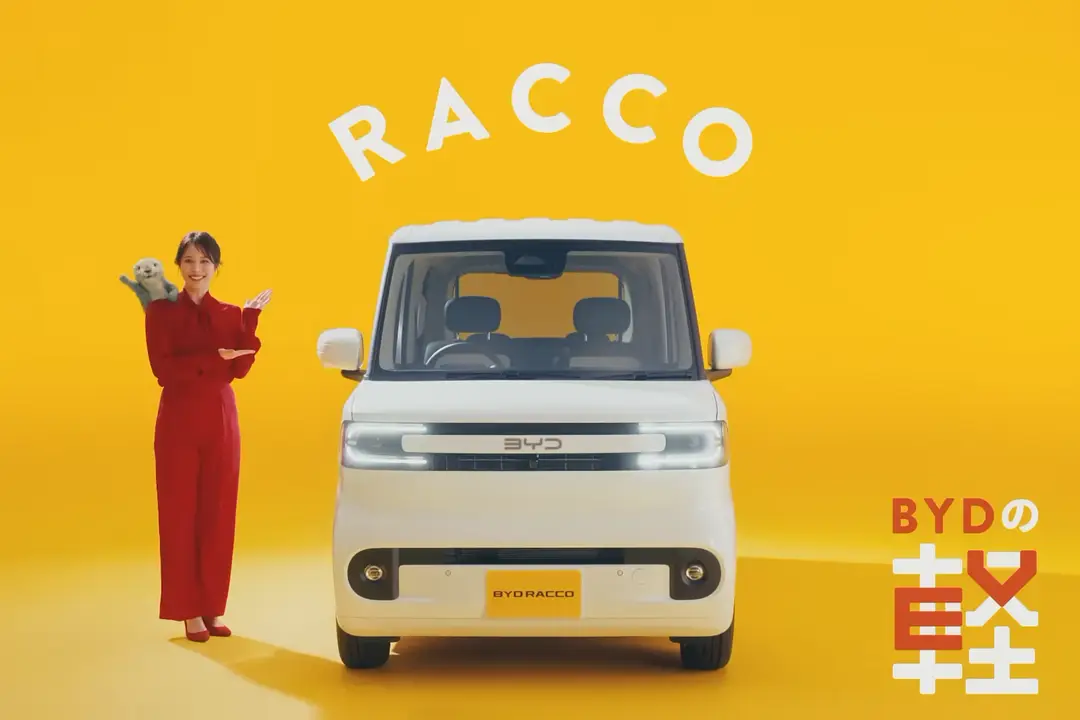
BYD’s bespoke electric “kei car” faces steep subsidy hurdles and cultural headwinds as it tests a new global architecture.
By Da Cheung
BYD (1211.HK) (002594.SZ), China’s leading electric vehicle (EV) manufacturer, has officially entered the most heavily protected segment of Japan’s automotive market, launching a bespoke EV model designed specifically for local roads. The release of the Racco — named after the sea otter — marks the first time a foreign automaker has mass-produced a vehicle for Japan’s unique “kei car” category.
These ultra-compact, low-power vehicles are a Japanese cultural and economic staple, accounting for roughly 40% of the country’s new car sales. Because they are required to adhere to strict dimensional and engine regulations to qualify for tax and insurance benefits, the segment has long acted as a non-tariff barrier, dominated entirely by domestic legacy automakers.
By spending years developing a vehicle exclusively for this niche, BYD, China’s second-biggest battery maker by market share, is signaling a highly aggressive push into a market where foreign brands historically fail. However, it faces steep cultural, structural, and political headwinds as it attempts to win over Japanese consumers.
Subsidy hurdles and a feature-heavy strategy
BYD is exporting the Racco to Japan from China and the car, which officially went on sale in July, has a suggested retail price starting at 1.95 million yen ($11,908) before taxes and subsidies. But the company’s initial strategy of undercutting local competitors on price has been neutralized by recent Japanese policy shifts. In April 2026, the Japanese government updated its clean energy vehicle subsidy program to heavily favor manufacturers that source batteries domestically.
As a result, buyers of the Racco receive only 150,000 yen ($916) in national subsidies, compared with the 580,000 yen ($3,542) granted to buyers of Nissan’s Sakura, Japan’s best-selling electric kei car. In Tokyo, where local incentives are factored in, the subsidy gap widens further, making the Chinese vehicle significantly more expensive than its local rivals.
To offset this financial disadvantage, BYD is deploying a “feature-stuffing” strategy. According to the company, the Racco offers a driving range of up to 320 kilometers, outperforming the 180-kilometer range of competitors like the Sakura and Mitsubishi‘s eK X EV.
The Racco is also the first electric kei car to feature powered sliding doors, a highly sought-after convenience in Japan. Crucially, it includes vehicle-to-home (V2H) technology, allowing the car’s battery to act as an emergency power source for a house — a major selling point in disaster-prone Japan where the government encourages household backup power.
Cultural headwinds and demographic lifelines
Despite the Racco’s localized design and superior range and features, BYD’s path to profitability in Japan remains fraught. Since entering the Japanese passenger car market in early 2023, the company had sold only about 7,400 vehicles by the end of 2025. It has an ambitious target of 10,000 orders for the Racco by the end of 2026.
The brand will have to overcome Japanese consumers’ intense loyalty to domestic automakers like Honda, which is also developing its own electric kei car. Furthermore, Japan’s electric vehicle penetration remains exceptionally low at around 3%. High public charging costs mean that EVs are primarily economically viable only for consumers living in single-family homes with private chargers.
Geopolitical skepticism toward Chinese products also presents a barrier. A recent television commercial for the Racco, which was heavily stylized to mimic Japanese domestic ads and featured popular Japanese actress Alice Hirose, sparked backlash from some nationalist Japanese internet users simply because she endorsed a Chinese brand.
Despite these challenges, the vehicle may find an initial foothold through demographics. Pan Nini, a professor at East China Normal University, noted that Chinese expats now make up nearly 1% of Japan’s population, providing a potential baseline of consumers willing to support a Chinese brand.
BYD is offering a financing plan with a guaranteed minimum residual value of 50% of the original price after five years, aiming to ease buyer concerns over depreciation. However, Japanese media points out this is a weak guarantee; if the car’s actual market value drops below 50% within that timeframe, the buyer is still responsible for paying the difference.
A Trojan horse for global expansion
Developing a bespoke platform for Japan’s low-margin kei car market appears financially risky, but industry analysts suggest the Racco is a strategic testing ground.
According to Japanese outlet JBPress, the Racco is the debut vehicle for BYD’s new “X-PACK” architecture — a design that uses the battery as the vehicle’s central control unit to maximize interior space and energy efficiency.
By proving this compact architecture in Japan, which has the world’s strictest size constraints combined with high crash-safety requirements, BYD is reportedly preparing the platform for a broader global rollout. The technology is ultimately aimed at Europe’s proposed new small EV categories but also at emerging markets and even the Chinese market, where low-cost, high-tech compact cars could see high demand.
The Racco’s debut signals a broader Chinese incursion into Japan’s auto sector. Chery (9973.HK) has established a joint venturewith Japanese partners to launch localized electric kei cars by spring 2027, utilizing Japanese engineers for the vehicle’s design. Meanwhile, Wuling has already secured the top market share in Japan’s electric logistics sector by manufacturing commercial EVs tailored for local delivery fleets.
Feature photo: BYD Racco’s TV commercial in Japan.
Sources
- 广濑爱丽丝一笑,揭开了日本汽车最后的“遮羞布”
- 比亚迪专供日本的这台车,我是真想他卖回国内。
- 比亚迪在日本下的新赌注
- China’s BYD enters Japan’s mini-car market with low-cost EV
- 比亚迪强势轰入日本汽车市场,这次“黑船”上坐的是中国人
- BYD初の軽EV「ラッコ」は日本で売れるか、214万円台からの価格と航続距離320kmに秘めた世界戦略
***