

Despite a landmark implant, China’s brain-computer interface startups face grueling rehabilitation realities and prohibitive out-of-pocket costs for patients.
By Da Cheung
On July 13, a patient paralyzed for a decade following a car crash underwent surgery at Huashan hospital in Shanghai to receive a brain-computer interface, or BCI — a device that translates brain signals into commands for external equipment. The hospital and the device’s maker, Neuracle Medical Technology, touted the procedure as the world’s first commercial BCI implant.
The milestone highlights China’s aggressive push to commercialize neurotechnology, leveraging rapid regulatory approvals and vast clinical resources to challenge U.S. dominance in a sector famously championed by Elon Musk’s Neuralink. Neuracle’s device moved from approval by Chinese regulators to a commercial medical prescription in just four months — a process that would normally take over a year. Yet, as the initial hype settles, the domestic BCI industry faces a sobering reality: building the technology is only the first step; proving its long-term safety and making it affordable are the real battles.
The reality of ‘mind control’ and safety hurdles
To understand the global BCI race, it helps to look at where the hardware actually goes. The industry is split into three main routes. Non-invasive devices sit on the head like a cap, offering high safety but weak signal quality. Fully invasive devices, like those developed by Neuralink, penetrate deep into brain tissue to capture precise signals, but carry significant surgical risks.
Neuracle’s NEO system takes a middle path. It is “semi-invasive,” meaning the coin-sized implant sits just outside the brain’s protective membrane. It does not pierce brain tissue, sacrificing some signal precision in exchange for lower surgical risk.
Despite the futuristic appeal, medical experts are quick to dispel the sci-fi myth of instant mind control. Mao Ying, president of Huashan Hospital, said that the implant is not a magical device that works immediately upon installation. Instead, it is a rehabilitative tool. Patients must undergo grueling training for six hours a day for over a month just to regain basic hand grasping functions.
Widespread clinical rollout is also constrained by severe logistical and safety hurdles. Currently, the device is only approved for a narrow demographic of patients with severe spinal cord injuries. Furthermore, BCI Naoji, a Chinese industry blog, flagged concerns over long-term stability, noting that Neuralink previously struggled with retracting electrode wires inside a patient’s head. Chinese companies have yet to prove their devices can remain stable in the human body over a lifetime. Scaling the procedure is another bottleneck, as China faces a shortage of neurosurgical teams trained to perform these specific implants.
The payment bottleneck
A key hurdle for BCI adoption is financial. Industry insiders estimate the total cost of Neuracle’s BCI implant system to be between 300,000 and 500,000 yuan ($41,500 to $69,200).
In China, citizens rely heavily on the national basic healthcare system. While state medical insurance covers the roughly 6,000 yuan surgical fee for the implant procedure, it does not cover the cost of the implant itself.
To bridge this kind of gap, the Shanghai municipal government has been supporting a local commercial supplementary health insurance fund, which has a coverage cap of 150,000 yuan and so in theory could cover 30% of the device’s cost. But even with this pioneering coverage, patients still face out-of-pocket costs exceeding 240,000 yuan — a prohibitive sum for families on average incomes or below.
This hybrid insurance model is a critical experiment for the nation. Zhu Yi, founder of the oncology drug development company Biokin, told The Insight Asia that because of the lack of broad commercial insurance coverage in China, his biotech has struggled to generate meaningful revenue at home. Until basic medical insurance absorbs the cost, or commercial insurance expands significantly, BCI technology will remain inaccessible to the vast majority of the 3.7 million spinal cord injury patients in China.
A booming market with elusive profits
Despite the financial bottlenecks for patients, venture capital is flooding the Chinese BCI sector. Startups like NeuroXess, BrainCo, and StairMed are racing through clinical trials with various invasive and non-invasive technologies.
Neuracle recently filed for an initial public offering on Shanghai’s tech-focused STAR Market, aiming to raise 2.5 billion yuan. However, the financial reality of these startups is bleak. According to its prospectus, Neuracle lost 230 million yuan in 2025. The company currently survives by selling conventional, non-invasive electroencephalogram (EEG) equipment to hospitals and researchers. It does not expect its invasive or semi-invasive implants to turn a profit until at least 2029.
While the U.S. maintains a strong edge in foundational research and fully invasive technologies — backed by decades of state funding — Chinese firms are capitalizing on their engineering speed and a fast-tracked regulatory system. But as companies transition from research labs to hospital wards, they are discovering that regulatory approval does not guarantee commercial viability. The ultimate winner of the BCI race may not be the company with the most advanced electrodes, but the one that figures out a sustainable business model.
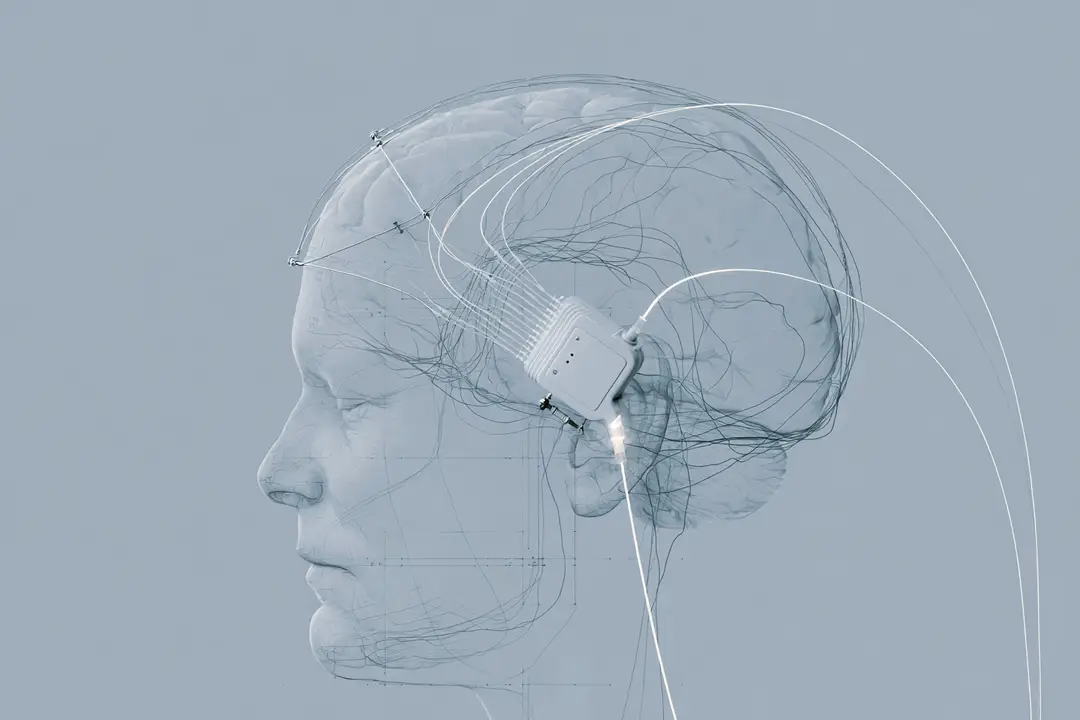
Feature photo: AI generated conceptual illustration of an implanted BCI
Sources