

By Da Cheung
In a move that signals growing momentum for next-generation chassis technology, Millisecond Intelligent Control, a Shanghai-based steer-by-wire (SBW) startup founded by a former Huawei employee, recently secured tens of millions of yuan in an Angel+ funding round.
The investment, led by Green Pine Capital Partners and state-backed Suzhou Hi-Tech Venture Capital Group, highlights a broader industry shift toward SBW systems. Unlike traditional steering that relies on a physical column connecting the steering wheel to the tires, SBW relies entirely on electrical signals to execute steering commands.
The concept is not new. It first proved its robustness in the 1970s from “fly-by-wire” technology pioneered in the aviation industry, stripping away mechanical linkages in aircraft like the F-16 fighter jet and Airbus A320 to achieve extreme maneuverability and reduce weight. In automobiles, SBW allows for a dynamic steering ratio. At low speeds, a slight turn of the wheel can sharply angle the tires, significantly reducing the turning radius especially when combined with rear-wheel steering. This makes navigating narrow streets or parking large vehicles effortless. At highway speeds, the system reduces sensitivity to maintain stability and provides a smoother ride.
For decades, this technology remained largely experimental, sidelined by safety concerns and high costs. But with rapid advancements in software and electronic hardware, automakers globally are finally putting it on the road in mass-produced vehicles.
Bumpy road to commercialization
Despite its conceptual origins tracing back to American supplier TRW in the 1950s, SBW has experienced a rocky path to commercialization. In 2013, Nissan’s Infiniti car brand introduced the technology in its Q50L model, but regulatory constraints forced the retention of a mechanical column, and the vehicle was later recalled over an SBW safety issue.
The primary hurdle has been functional safety. Because SBW completely decouples the steering wheel from the wheels, any electronic failure could be catastrophic. To meet stringent safety standards, a modern SBW system requires massive redundancy. It requires dual motors, dual power supplies, dual communication channels, and dual software architectures, ensuring that a backup system can seamlessly take over if one fails.
For example, IM Motors, a Chinese EV brand backed by state-owned automaker SAIC, uses a dual SBW system coupled with rear-wheel steering on its LS8 model. If both SBW systems fail, the rear-wheel steering can still guide the vehicle safely to a stop, achieving a failure probability of less than 10 FIT, or Failures in Time, a standard functional-safety metric. FIT represents the probability of a component failing once per one billion hours of operation. A metric of under 10 FIT meets the industry’s most stringent safety requirements for critical components.
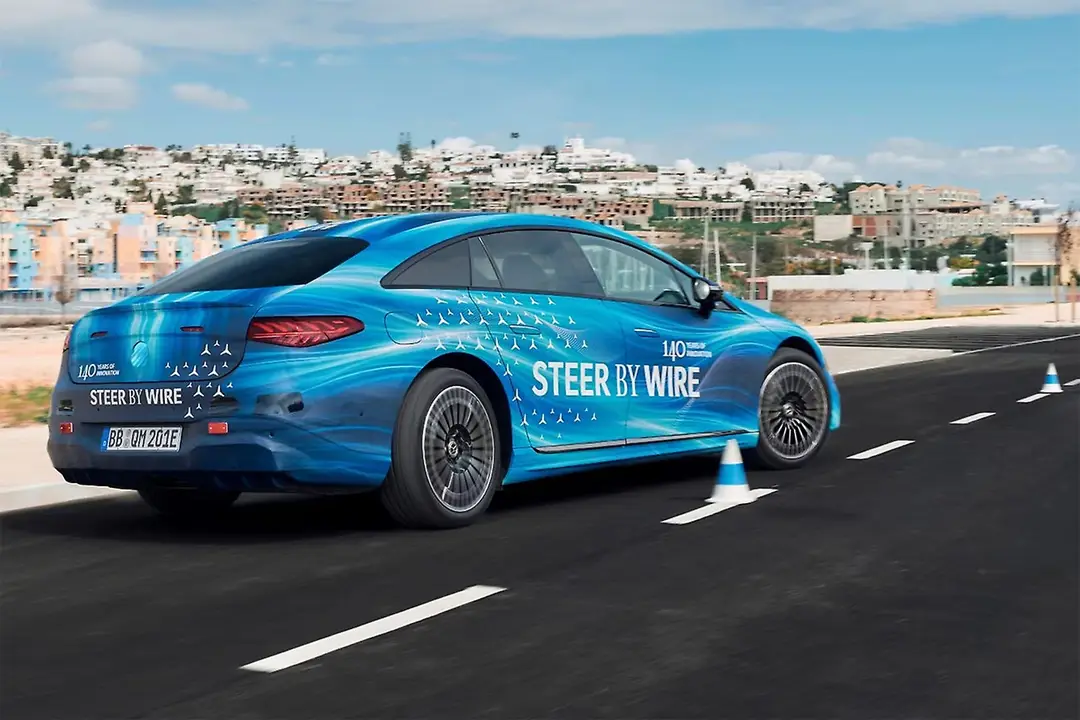
According to German automaker Mercedes Benz, unwelcome vibrations from uneven roads can be eliminated entirely on its new EQS model that comes with SBW technology. This could be good news for most drivers, but some would complain about the loss of “road feel” — the tactile feedback drivers receive from mechanical steering. To address this, some developers have designed specialized resistance actuators that simulate vibrations and road textures, ensuring drivers remain engaged.
Automakers embrace the wire
After years of hesitation, the auto industry is betting on the technology. The breakthrough arguably arrived in late 2023 with the launch of Tesla’s Cybertruck, the first production vehicle to completely remove the steering column and make SBW standard across its lineup. Tesla’s system allows the massive pickup to complete a full turn with the steering wheel rotating just 340 degrees, slightly less than one full turn.
Mercedes-Benz’s CEO, Ola Kallenius, told investors during an earnings call that SBW is a “thoroughly transformative innovation.” The German automaker says its system has undergone over 1 million kilometers of testing on rigs, with a similar amount of mileage logged on test tracks and public roads.
Chinese automakers are following closely. Nio introduced the technology in its ET9 flagship sedan in late 2024, with an SBW system made by German tech group ZF. Other Brands including Li Auto and Xpeng have also equipped their flagship models with the technology.
Leading automotive parts suppliers are investing heavily to meet surging global demand. Germany-based Schaeffler and Bosch are expanding their chassis portfolio to include SBW systems with force-feedback actuators. Meanwhile, startups are capitalizing on the supply chain shift. Unlike most startups, which tend to take on the full assembly directly, Millisecond Intelligent Control has adopted a more pragmatic commercial approach. The company has already joined entered the supply chain of a leading North American EV maker and completed the development and delivery of its first project.
The ultimate driving machine without a steering wheel
Industry analysts project that 2026 will be the breakout year for SBW. This timeline aligns with the implementation of China’s updated national steering standards in July 2026, which officially remove the requirement for mechanical linkages, opening a critical regulatory window.
For automakers, SBW serves as a compelling marketing hook, helping brands stand out in the wave of intelligent vehicle competition by offering consumers a futuristic driving experience characterized by rectangular steering wheels and effortless maneuverability. But more importantly, it is the fundamental physical infrastructure required to maximize the advantages of autonomous driving.
Human reaction times to driving hazards typically range from 390 to 600 milliseconds. SBW systems bypass human physiological limits entirely, responding in tens of milliseconds — up to 10 times faster than a human driver.
By fully decoupling the steering wheel from the tires, automakers also gain the flexibility to completely redesign vehicle interiors. As the industry transitions toward advanced autonomous driving, mechanical columns will become increasingly obsolete. Eventually, most cars may mirror the Cybercab by operating without a traditional steering wheel entirely. Until then, SBW will be the technology that serves the physical link between the driver’s hands and the road.
Sources