
By Da Cheung
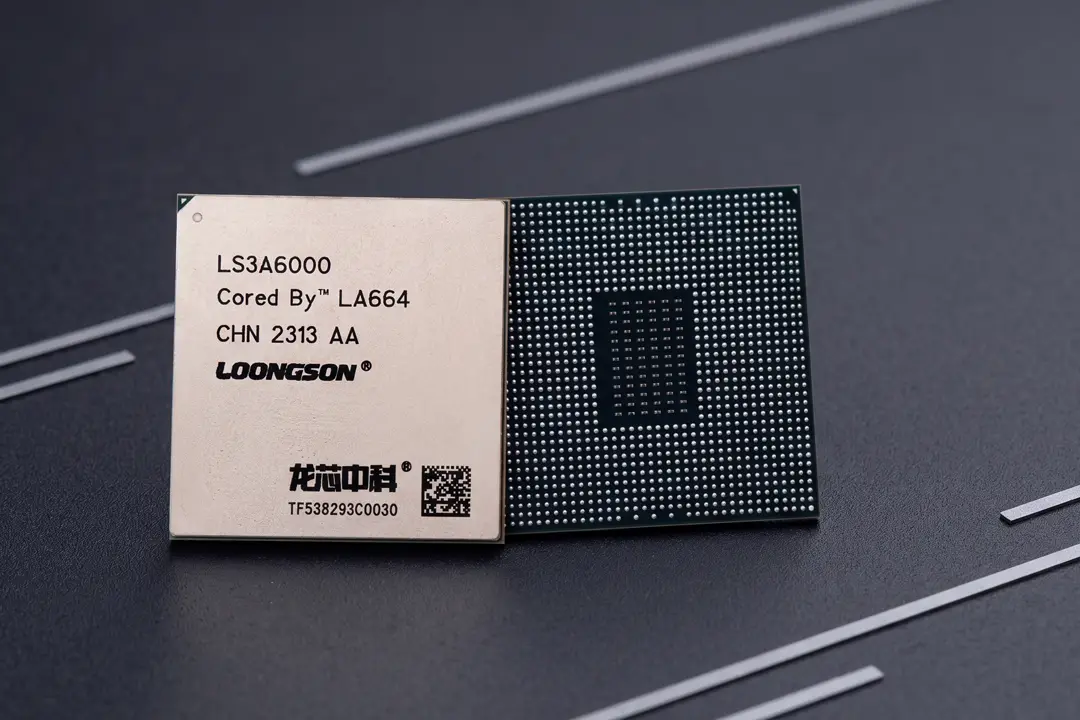
Loongson Technology (688047.SH) recently shipped its one-millionth 3A6000 desktop CPU, basically the main brain of a computer. To industry giants like Intel and AMD, a million units might represent a fraction of a single quarter’s global sales. But for China, this modest number marks a significant triumph in its quest for technological self-reliance.
Released in 2023, the 3A6000 is widely regarded within China as the country’s first processor built to contemporary global standards. The company says it was developed entirely on an independent instruction set architecture — essentially the abstract model that defines how the CPU is controlled by the software — without relying on foreign intellectual property. Operating at a base frequency of 2.5 GHz and featuring simultaneous multithreading (SMT), the processor achieves performance on a par with a 10th-generation Intel processor from 2020, according to benchmark scores cited by industry publication Hardware World.
The one million units have already been widely deployed across taxation, education, and government sectors, with over a hundred thousand systems installed in public schools across multiple provinces alone.
The invisible hand of the state
Why would an ecosystem pivot toward a CPU that is roughly three years behind the bleeding edge? The answer lies in Beijing’s “Information Technology Application Innovation” policy, known in China as Xinchuang.
The Xinchuang strategy aims to systematically replace Western hardware and software — particularly products from vendors like Microsoft, IBM, and Oracle — across critical infrastructure like finance, telecommunications, energy, and government operations. State-backed entities, government offices, and the military are essentially forced buyers, creating a captive domestic market that was projected to reach 4.23 trillion yuan ($587 billion) by 2027, according to a report by third-party testing provider Yingli Standard Testing Technology.
The government mandate guarantees a stable, albeit niche, pipeline of revenue for companies like Loongson. Shielded from the open market’s brutal duopoly of x86 and Arm Holdings architectures, domestic manufacturers have the financial breathing room to iterate on their designs. The state’s true intention is not just economic protectionism, but rather to forge a completely independent IT supply chain. This ensures that government and military networks operate with the highest security clearance and remain completely insulated from future export controls imposed by Washington.
From state labs to the open market
The milestone of one million shipments is the culmination of more than two decades of state-sponsored research. Loongson originated as a specialized research group at the Chinese Academy of Sciences in 2001 to break the international monopoly on chip technology, and was later incorporated into a partially state-owned commercial entity in 2010.
It took the company roughly 20 years to close the gap from lagging generations behind to approaching the industry average. By the time Loongson went public on Shanghai’s STAR Market in 2022, the influx of capital had dramatically accelerated its product development cycle. The shares have almost doubled since listing and were trading at 166 yuan on May 20, giving it a market capitalization of around 64 billion yuan.
Last June, Loongson unveiled the 3C6000, a next-generation CPU targeting server and enterprise data centers. The company’s chief designer claims that the 3C6000 achieves performance parity with mainstream products from 2023 and 2024, operating entirely without foreign technology licenses or offshore supply chains. To compete in modern data centers, the company is utilizing advanced packaging to combine multiple 3C6000 chips into even more powerful 32-core and 64-core iterations. To make these processors communicate seamlessly, the manufacturer says it has developed an entirely homegrown high-speed interconnection technology called “LoongLink,” a critical component that has similar features to Nvidia’s NVLINK.
The company is also expanding its ambitions well beyond CPUs. Loongson completed the design of its 9A1000 graphics chip in September 2025 and sent it to a factory for manufacturing — a step known in the industry as taping out. Engineering samples are expected by the end of 2026 and production is slated for 2027, according to the company’s May 2026 earnings call. It is positioned as an entry-level discrete GPU for basic AI acceleration and graphics rendering — roughly comparable to an AMD Radeon RX 550 —rather than high-end gaming, and underscores a broader effort to replicate the comprehensive hardware ecosystems offered by American rivals.
A sandbox for future competitors
Historically, Chinese chipmakers survived by purchasing third-party designs from Western firms or by licensing existing architectures. But as geopolitical tensions mount, the overarching strategy has firmly pivoted toward self-developed ecosystems.
Much like how Chinese GPU startups have used Washington’s embargoes as a catalyst to seize domestic market share, CPU developers are adopting a similar playbook. They leverage Beijing’s political and financial support to overcome the initial, most painful stages of technological development.
The deployment of one million 3A6000 units represents a successful proof-of-concept for this strategy. The company asserts that independent control is no longer just a slogan, and that domestic self-developed technology is shifting from policy-driven deployments to actual market verification.
While Loongson and its domestic peers are not yet ready to topple Intel or AMD on the global stage, they are no longer just academic experiments. Nurtured by guaranteed state contracts and hardened by the urgency of U.S. sanctions, these homegrown tech enterprises may be quietly gathering the momentum needed to eventually compete in the open market.
Sources
- 龙芯3A6000主流行业出货量突破100万片
- 我国纯自主CPU!龙芯3A6000主流行业出货量突破100万片
- 龙芯首款GPU,准备好了
- 我国自主研发新一代CPU发布,无需依赖任何国外授权技术
- 龙芯眼里的国产CPU:三条路线
- 科普|信创是什么?一文读懂“信息技术应用创新”战略
- 2021年中国信创产业研究报告
- 龙芯3A6000重磅发布,国产自主CPU的进击之路!
- 一心一意做好“龙芯”产业化