
By Da Cheung
After scouring the market for promising AI chip designers and foundational model builders, venture capitalists may have found their next potential gold mine.
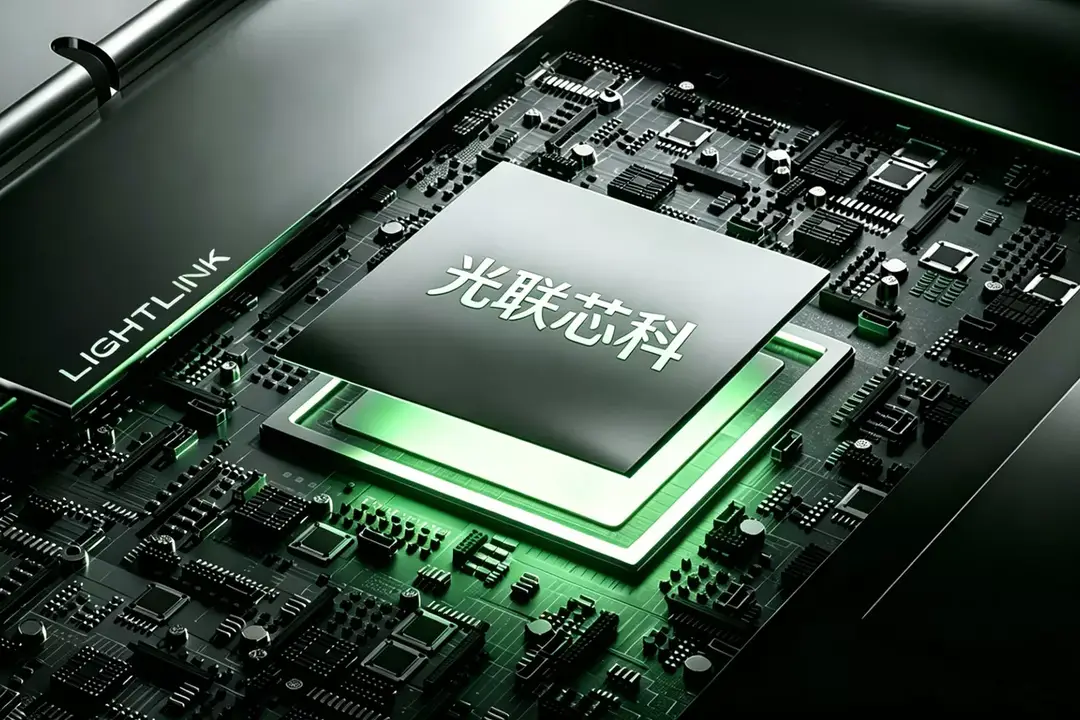
On June 3, Chinese optical interconnect startup LightLink Tech (Guanglian Xin Ke) announced the completion of a Series A funding round worth nearly 500 million yuan ($69 million). The company, which focuses on optical input/output (OIO) technology for artificial intelligence computing, claims its latest valuation has shattered domestic records for startups in this niche.
While much of the optical interconnect sector remains pre-revenue and deep in the research phase, it is currently driving investors across both primary and secondary markets into a frenzy. On the same day as Light Link Tech’s announcement, Semight Instruments (Suzhou Lianxun Yiqi) (688808.SH) — a company that simply provides testing equipment for optoelectronic devices — became only the fourth company in the history of China’s A-share market to see its share price break through the 2,000 yuan milestone. The company listed on the Shanghai bourse’s STAR Market six weeks ago at an IPO price of 81.88 yuan.
We previously reported on Lightelligence, whose IPO was oversubscribed more than 5,700 times in its Hong Kong retail offering. Most core optical hardware developers, however, are still in the early funding stages rather than listed on public exchanges. Last month, another startup named PhotonCore (Guangzi Xin Li) secured tens of millions of yuan in angel funding.
Breaking the energy wall
The sudden pivot toward optical hardware stems from a fundamental bottleneck in modern AI development. In massive computing clusters using tens of thousands of GPUs, an astonishing 90% of the system’s total energy consumption is spent on moving data around rather than executing calculations. Traditional copper wire interconnects have reached physical limits, generating excess heat and sharply restricting data transmission distances to mere centimeters at high speeds.
Optical interconnect technologies — particularly co-packaged optics (CPO) — are emerging as the optimal solution. CPO involves integrating optical components directly alongside processing chips, shifting data transmission from electrical signals to optical signals, dramatically improving speed, efficiency, and scalability. According to industry reports, this architecture can reduce interconnect power consumption by about 70% and boost bandwidth density by a factor of 10.
“Electricity is better at computing, and light is better at connecting,” Chen Chao, CEO of LightLink Tech, said at an industry forum, “What we do is pave a ‘light-speed highway’ between AI chips.” The company says its technology can directly convert electrical signals to optical signals within the chip package, bypassing the signal losses inherent in traditional circuit-board interconnects.
The concept is expanding rapidly into the connection between memory and computing chips. According to a May 2026 report by TrendForce, major memory manufacturers are exploring optical fiber links to connect high bandwidth memory (HBM) directly to GPUs, aiming to exponentially increase memory capacity within strict physical space constraints.
The Nvidia catalyst and market frenzy
While the technology has been in development for years, the current investment mania was triggered by Silicon Valley. At this year’s GPU Technology Conference, Nvidia CEO Jensen Huang explicitly stated that next-generation AI infrastructure must pivot entirely to optical connections. This endorsement, coupled with Nvidia’s reported $2 billion investment in global optical component giants Lumentum and Coherent, acted as the starter pistol for Chinese investors.
According to China Venture, almost every domestic investment institution is now actively looking for optical chip projects. However, a stark supply-demand imbalance exists. As of April 2026, there were fewer than 100 core optical chip manufacturing and design firms operating in China.
This scarcity has led to astronomical valuations driven by fear of missing out. One pre-commercialization optical device startup, valued at roughly 100 million late last year, saw its valuation surge to 900 million yuan within months as dozens of institutions aggressively competed for equity. In some instances, venture capitalists are opting to incubate their own startups from scratch — using talent from elite institutions like Tsinghua University and MIT — rather than pay extreme premiums.
A pathway to technological self-reliance
For China, the optical interconnect boom represents more than just a financial trend — it offers a strategic workaround. As the nation faces ongoing constraints limiting its access to advanced semiconductor manufacturing nodes, the domestic tech industry is shifting its focus from single-chip performance to system-level optimization. Huawei went for stacking, a lot of others went for optical interconnects.
If Chinese AI chips can be linked using ultra-high-bandwidth, low-power optical networks, the collective system could potentially rival or outpace foreign hardware that relies on superior individual chip architectures. Furthermore, national infrastructure initiatives demand massive cross-regional data scheduling that traditional interconnects can no longer support.
Crucially, China already possesses a mature and highly competitive global supply chain in optical module manufacturing and packaging. The secondary market has aggressively rewarded these incumbents; shares in Suzhou-based Zhongji Innolight (300303.SZ), for example, have soared to 1,280 yuan from 545 yuan in just three months. Up-stream optical equipment manufacturer Yuanjie Semiconductor Technology’s (688498.SH) shares have rocketed to 1,374 yuan from 587 yuan over the same period.
Despite the stock market’s enthusiasm, significant challenges remain. Optical hardware engineering requires long, capital-intensive developmental cycles and the sector has yet to demonstrate its commercial viability at scale.
Sources