

While rival automakers Li Auto and Nio have seen their gross margins rise, Xiaomi’s profitability fell in the third quarter as its product mix shifted and costs rose.
By Yang Jie
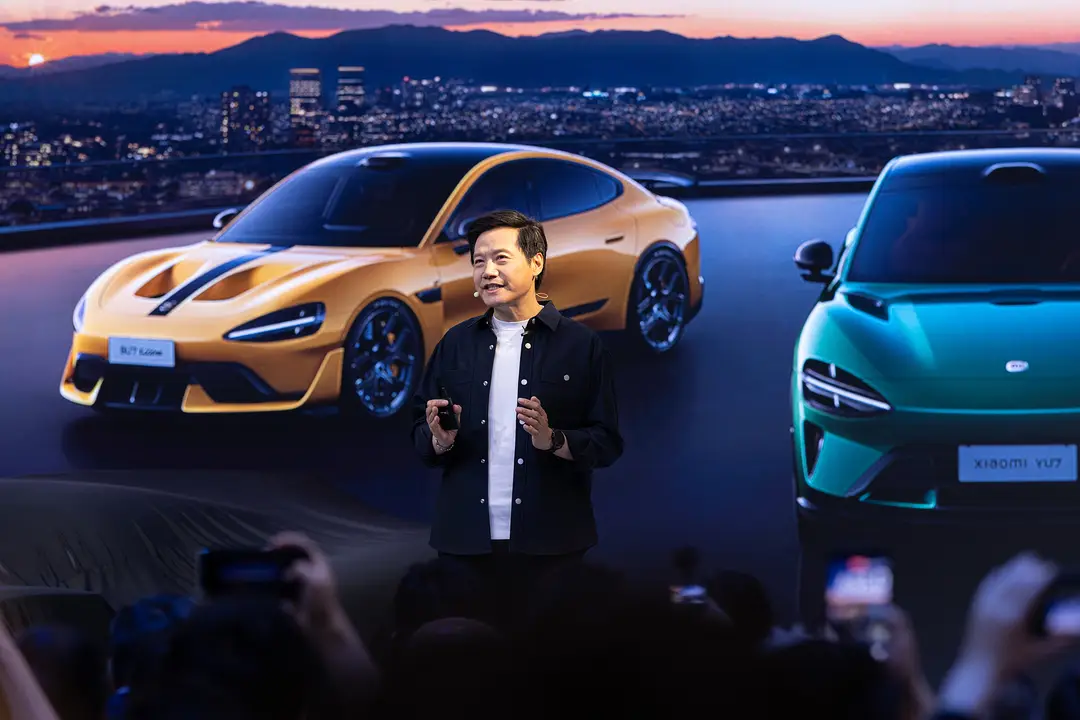
In February 2025, Xiaomi (1810.HK) founder Lei Jun unveiled the new SU7 Ultra wearing a leather jacket similar to one made famous by Nvidia CEO Jensen Huang.
Starting at 529,900 yuan ($79,393), the model became Xiaomi’s most expensive car and quickly established itself as a flagship product. More than 10,000 orders were placed within three days of its launch.
The jacket itself became a social media sensation, selling out as excitement around the car reached fever pitch.
But the SU7 Ultra, once a symbol of Xiaomi’s ambitions to build premium cars, is now approaching the end of its commercial life. Its monthly insurance registrations fell to just 57 in July, 56 in August and 50 in September, for a quarterly total of approximately 163.
That is a negligible contribution to a business delivering more than 100,000 vehicles a quarter.
As the high-priced model fades from the lineup, Xiaomi’s automotive profitability is coming under pressure.
Third-quarter results showed that revenue from Xiaomi’s electric vehicle business fell 19.9% year on year to 22.7 billion yuan. The broader segment covering electric vehicles, AI and other innovative businesses recorded an operating loss of 3.4 billion yuan, 800 million yuan more than in the second quarter. A year earlier, it had generated an operating profit of 700 million yuan.
More concerning was the decline in automotive gross margin, which dropped to 19.2% from 25.5% a year earlier, a fall of 6.3 percentage points.
Falling margins meet rising costs
The deterioration came despite relatively resilient vehicle deliveries. Xiaomi handed over 100,975 vehicles in the third quarter, down just 7.2% year on year.
The contrast is striking: deliveries fell by a single-digit percentage, but revenue declined by almost 20%, while the broader innovative businesses segment swung from profit to a substantial loss.
Xiaomi attributed the decline in gross margin to three factors: a lower proportion of SU7 Ultra deliveries, higher prices for key components and increased costs associated with its AI business.
The first reflects a fundamental change in the product mix. The high-margin SU7 Ultra is disappearing from the delivery figures, while the company increasingly depends on higher-volume, lower-priced models. But the transition has yet to demonstrate that greater scale can compensate for thinner margins.
Component inflation is adding to the pressure. Across China’s automotive supply chain, prices have risen sharply in 2026. Lithium carbonate spot prices climbed from approximately 75,000 yuan a tonne at the end of 2025 to a peak of 200,000 yuan, an increase of more than 160%, before subsequently retreating. Prices nevertheless remain above year-earlier levels.
Automotive-grade memory chips have seen price increases of as much as 180% in three months, while some high-end intelligent driving chips have risen by more than 300%. Suppliers of connectors and other components have also announced multiple price increases, with some categories recording double-digit rises. Copper, aluminium and silver prices have also climbed.
Estimates disclosed by listed automakers suggest that higher lithium, chip and metal costs have added approximately 6,000 yuan to 14,000 yuan to the production cost of a typical mid-sized intelligent electric vehicle. Nio (NIO.US) reported an increase of about 14,000 yuan in vehicle costs per unit compared with the end of 2025, while AITO, the EV brand backed by tech giant Huawei and made by Chinese automotive group Seres (601127.SH) put the increase at between 15,000 yuan and 20,000 yuan.
These pressures are industry-wide rather than specific to Xiaomi. Its smartphone business also suffered a gross-margin decline, from 11.1% to 9.2%, primarily because of higher component costs.
The financial arithmetic is nevertheless challenging. At a gross margin of 19.2%, automotive revenue of approximately 22.7 billion yuan generated around 4.35 billion yuan in gross profit. Operating expenses for the broader innovative businesses segment approached 8 billion yuan, up 18.6% year on year.
With product mix eroding gross profit while research and development, distribution and AI expenditure continued to rise, the segment swung into the red.
The questions hanging over the fourth quarter
The disappearance of the SU7 Ultra’s contribution is unlikely to reverse. Xiaomi’s delivery mix will increasingly depend on the YU7, the standard SU7 and its new SkyNomad extended-range SUV, known as Pengcheng in Chinese, which starts at 209,900 yuan.
Launched in September, the SkyNomad secured more than 70,000 orders in its first month, although only around 10,000 units were delivered during the third quarter.
Whether Xiaomi’s 19.2% gross margin represents a temporary trough caused by the product transition or a new, lower operating level remains unclear. Comparisons with other Chinese electric vehicle makers offer some perspective.
Nio reported a second-quarter overall gross margin of 18.4% and a vehicle gross margin of 18.5%. It expects automotive margins in the third quarter to remain broadly unchanged. Li Auto (2015.HK) meanwhile, reported an overall gross margin of 11% and a vehicle margin of 9.4% in the second quarter, recovering from a first-quarter low.
In absolute terms, Xiaomi’s 19.2% margin looks relatively healthy.
But the direction of travel matters more. Nio has been rebuilding margins from around 10%, while Li Auto is recovering from a low of 6.1%. Xiaomi, by contrast, has seen its margin fall sharply.
The same gross-margin figure can tell very different stories depending on whether a company is climbing towards it or sliding away from it.
Nio and Li Auto are demonstrating that margins can recover. Xiaomi’s third-quarter results have yet to establish whether 19.2% is a floor or another step down.
If margins remain around 19% or fall further after the SkyNomad ramps up deliveries in the fourth quarter, it would raise questions about whether the extended-range SUV can generate sufficient profit per vehicle to replace the contribution previously made by Xiaomi’s premium models.
Xiaomi has already pursued a scale-for-profit strategy in smartphones, where hardware sales are supported by recurring internet services revenue. Its automotive business has no equivalent cushion.
Every yuan of automotive profit must ultimately come from the vehicles themselves and related services. As the SkyNomad becomes a larger part of deliveries, the question is no longer simply whether Xiaomi can sell more cars, but whether it can make enough money on each one.
The fourth quarter will show whether 19.2% marks the bottom of a temporary transition or the new normal for Xiaomi’s automotive business.
Source:
Huxiu Auto