

The Chinese company is broadening its autonomous vehicle technology into mining robotics and industrial logistics, while narrowing losses and pursuing overseas markets.
By Doug Young
Chinese autonomous driving company CiDi (3881.HK) is expanding beyond driverless mining trucks into robotics and industrial logistics, seeking to build on its technology as demand for automation grows.
While companies such as Tesla and Waymo attract attention for autonomous passenger vehicles, CiDi has focused on less glamorous but potentially lucrative industrial applications. Its self-driving trucks are increasingly used at Chinese mines and industrial sites, where automation can improve productivity while reducing costs and risks to workers.
The company secured a significant order this year when miner Inner Mongolia Guangna Coal Industry Group agreed to purchase 500 autonomous vehicles, marking a major step in its commercial expansion.
CiDi is also moving into robotics, applying technologies developed for autonomous driving to machinery used in mining operations. The business generated its first commercial revenue in the first half of 2026, with the delivery of 34 robotic excavators.
The expansion comes as the company approaches profitability. CiDi reported an adjusted loss of 20 million yuan ($3 million) in the first half, significantly narrowing its deficit as shipments increase.
Broadening automation across mining operations
CiDi’s strategy is to move beyond autonomous haulage and automate more of the mining process, including excavation, drilling and blasting.
Its remotely operated excavators are already being used at operating mines, while the company is developing specialised robotic systems for drilling and explosives handling. These applications target some of the industry’s most dangerous and labour-intensive tasks.
It has also introduced the CDK155, a second-generation cabless electric mining truck designed specifically for autonomous operation, with a rated payload of 100 tons.
Another addition is Yura, an AI agent built on the company’s MetaMine platform. Using natural-language instructions, the system can interpret production requirements and coordinate equipment including autonomous trucks, excavators and drilling machines.
The ambition is to create a connected system capable of managing operations across an entire mine, rather than automating individual vehicles and tasks in isolation.
Robotics is a natural extension of CiDi’s existing technology, according to CEO Albert Hu. Autonomous vehicles and industrial robots share underlying capabilities in perception, decision-making, equipment control and coordination between machines.
The company believes this overlap will allow it to develop new products without building an entirely separate technology platform.
Moving into industrial logistics
Outside mining, CiDi is applying its autonomous driving systems to industrial parks, ports, cross-border freight and other heavy-duty logistics operations.
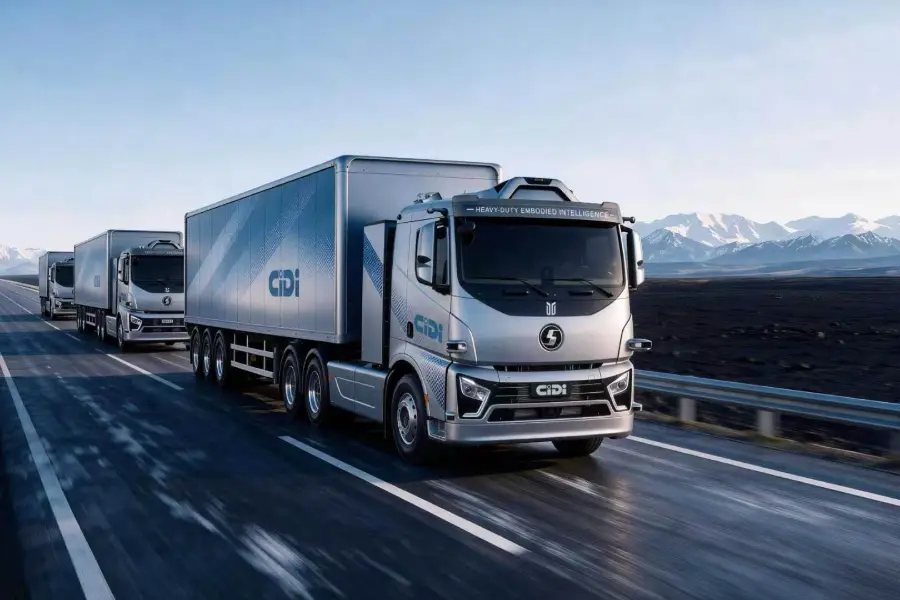
One of its latest products is VEGA, an L4 autonomous heavy-duty truck developed jointly with Zhizi Automobile Technology. Designed to operate both within controlled industrial facilities and on public roads, it aims to connect different stages of freight transportation using a single vehicle, avoiding the need to transfer cargo between trucks.
The product reflects CiDi’s ambition to extend autonomous driving beyond confined mining environments into more complex logistics networks.
The company had shipped a cumulative 1,900 autonomous trucks by the end of June, including more than 400 in the first half of 2026. Hu said its order book continued to grow and that cumulative shipments were expected to increase substantially by year-end.
Demand is being supported by mining companies’ efforts to improve operational efficiency and workplace safety, alongside growing regulatory attention to protecting workers in hazardous environments.
International expansion remains a longer-term goal
China remains CiDi’s largest market, but the company sees opportunities in other major mining regions, particularly Australia, South America and Indonesia.
Establishing an overseas presence will take time, Hu said, as customers need confidence in the technology and its ability to operate reliably in demanding conditions.
The company is building its international network through partnerships with established industry players. Its collaboration with MMD Group, which brings mining equipment expertise and an international industry network, is one example.
CiDi has also adopted an asset-light business model, selling vehicles to customers rather than retaining ownership and charging for their use as a service.
Under this arrangement, customers own and operate the vehicles, manufacturing partners handle vehicle engineering and production, and CiDi supplies the autonomous driving technology and integrated systems.
Hu said the approach allows each participant to concentrate on its core strengths. Although the company recognises the attractions of recurring service revenue, it does not currently intend to abandon its asset-light model.
For CiDi, the immediate challenge is to turn its growing range of applications into a sustainable commercial business. Narrowing losses and expanding shipments suggest progress, but its ambitions now extend well beyond the autonomous trucks that established its position in the market.
To subscribe to Bamboo Works weekly free newsletter, click here
