

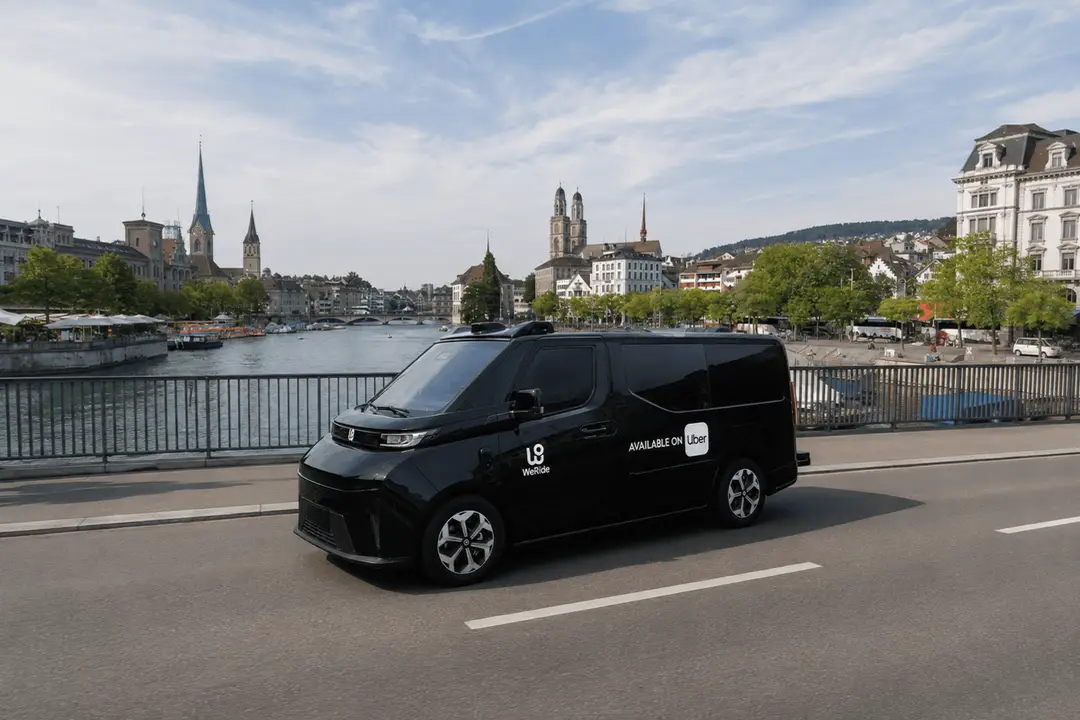
Higher margins, rapid overseas expansion and an asset-light business model are helping the autonomous driving company win investor favor over Pony AI.
By Doug Young
WeRide (WRD.US; 0800.HK) looks to be overtaking domestic rivals Pony AI (PONY.US; 2026.HK), and Baidu (BIDU.US; 9988.HK) in the race to commercialize robotaxis, as investors respond to its higher margins, expanding international operations and diversified business model.
The shift in sentiment is reflected in the relative performance of the companies’ shares and, more significantly, their underlying financial results. WeRide’s gross margin reached 43% in the third quarter, up from 32.9% a year earlier, the company reported on Nov. 20. Pony AI by contrast, reported a gross margin of 17.8%, down from 18.4% over the same period.
WeRide’s margin is more than twice that of its rival, highlighting the advantages of a business that extends beyond robotaxis into AI infrastructure and autonomous driving technology for other automakers.
Diversification provides a buffer
Robotaxis account for roughly one-third of WeRide’s business. Its other two main activities are AI infrastructure, serving customers in autonomous driving, robotics, embodied AI, and foundation models, and supplying Level 2 and Level 3 autonomous driving technology to automakers.
The diversified revenue base offers some protection in an industry exposed to regulatory uncertainty and operational setbacks. In March, more than 100 Baidu robotaxis suddenly stopped operating in Wuhan following a system failure, prompting Chinese authorities to slow the industry’s development while they conducted a review lasting several months. More recently, U.S.-based operator Waymo was ordered to suspend highway services following at least two safety-related incidents.
WeRide also benefits from an international business that is developing faster than its domestic operations. Overseas markets can offer better profitability than China, where competition is intense. Its asset-light approach, particularly outside China, also limits the capital required to expand its fleet.
The changing investor perception is evident in the companies’ share prices. WeRide is hardly a market success story in absolute terms: its shares have fallen about 65% this year and trade roughly 80% below their October 2024 U.S. IPO price.
But Pony AI has fared worse recently. Its U.S. shares were still above their November 2024 IPO price as recently as February, reflecting investor enthusiasm for its robotaxi progress. But they have since fallen 77% and now trade 74% below their IPO price.
WeRide has consequently moved ahead on valuation, with a price-to-book ratio of 1.94, roughly double Pony AI’s 0.97.
Overseas operations drive growth
WeRide operated about 4,100 autonomous vehicles worldwide at the end of September, including robotaxis, robobuses and robosweepers. Robotaxis accounted for more than 2,300 of these, up about 26% from the previous quarter.
Most of the robotaxis are in China, particularly Guangzhou, where the company is headquartered. WeRide said its Guangzhou fleet achieved positive unit economics during the third quarter, while its domestic robotaxis averaged 21 orders per vehicle per day.
Its international expansion, however, is becoming increasingly important. The company’s Middle East fleet reached about 600 robotaxis at the end of September, up 50% over the previous quarter, with most operating in Dubai and Abu Dhabi.
Outside China, WeRide relies on local partners to finance fleets and handle daily operations, reducing its own capital requirements. One of its largest partners is Uber (UBER.US), which WeRide describes as its biggest partner outside the U.S. Both Baidu and Pony AI also have partnerships with the ride-hailing company, while Pony AI similarly uses an asset-light model in some overseas markets.
WeRide’s third-quarter revenue rose 88% year on year to 321.5 million yuan ($48.2 million). Overseas revenue, consisting largely of autonomous vehicle operations, jumped 172% to 147 million yuan, approaching half of the company’s total. The rapid growth in this higher-margin business helped drive the improvement in overall gross margin.
The company is also expanding in Europe. It secured Spain’s first national operating permit for Level 4 autonomous passenger vehicles and reported progress in Switzerland, Belgium and France, while beginning road tests in Slovakia.
Losses and cash consumption remain concerns
WeRide provides less detail on its AI infrastructure and autonomous driving technology businesses, which together account for nearly two-thirds of revenue.
Revenue from AI infrastructure, generated through its Jingshuo Technology unit, nearly doubled in the third quarter, although the company did not disclose an absolute figure. Its WRD 3.0 system, which supplies Level 2 and Level 3 autonomous driving technology to automakers including Aion and GAC, had achieved cumulative deliveries of more than 100,000 units by the end of September.
The company nevertheless remains unprofitable. Its third-quarter net loss was 310 million yuan ($46.5 million), little changed from 307 million yuan a year earlier.
Cash reserves also declined sharply, falling to 3.85 billion yuan at the end of September from about 7 billion yuan at the end of last year. Chief financial officer Jennifer Li told investors that WeRide had more than four years of cash runway, which she said would be sufficient to finance its path to self-sustaining cash flow.
Analysts remain broadly positive on both WeRide and Pony AI, with almost all those covering the companies assigning buy or strong buy ratings. But the shifting fortunes of the two competitors underline how quickly investor sentiment can change in a market where both are still working to establish commercially sustainable robotaxi businesses.
Source:
Bamboo Works
To subscribe to Bamboo Works weekly free newsletter, click here